
|
Keyword: nebula
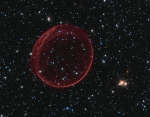 The Rippled Red Ribbons of SNR 0509
25.01.2011
What is causing the picturesque ripples of supernova remnant SNR 0509-67
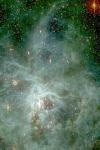 In the Heart of the Tarantula Nebula
27.10.1999
In the heart of monstrous Tarantula Nebula lies one of the most unusual star clusters. Known as NGC 2070 or R136, it is home to a great number of hot young stars. The energetic light from these stars continually ionizes nebula gas, while their energetic particle wind blows bubbles and defines intricate filaments.
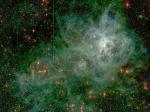 30 Doradus: The Tarantula Nebula
26.10.1999
30 Doradus is an immense star forming region in a nearby galaxy known as the Large Magellanic Cloud. Its spidery appearance is responsible for its popular name, the Tarantula Nebula, except that this tarantula is about 1,000 light-years across, and 165,000 light-years away in the southern constellation Dorado.
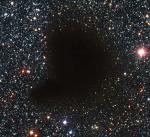 Molecular Cloud Barnard 68
11.05.1999
Where did all the stars go? What used to be considered a hole in the sky is now known to astronomers as a dark molecular cloud. Here, a high concentration of dust and molecular gas absorb practically all the visible light emitted from background stars.
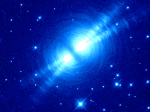 Searchlight Beams from the Egg Nebula
29.01.1996
The dramatic and mysterious looking object revealed in this Hubble Space Telescope image is known as the Egg Nebula. It is an aging star about 3,000 lightyears distant, entering its Planetary Nebula phase of evolution.
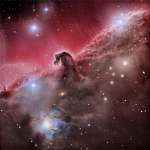 The Magnificent Horsehead Nebula
13.05.2010
Sculpted by stellar winds and radiation, a magnificent interstellar dust cloud by chance has assumed this recognizable shape. Fittingly named the Horsehead Nebula, it is some 1,500 light-years distant, embedded in the vast Orion cloud complex.
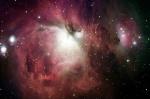 The Orion Nebula in Hydrogen
22.11.2000
The Great Nebula in Orion can be found just below and to the left of the easily identifiable belt of three stars in the popular constellation Orion. This fuzzy patch, visible to the unaided eye, contains one of the closest stellar nurseries, lying at a distance of about 1500 light years.
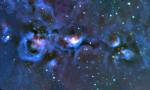 NGC 6334: The Bear Claw Nebula
6.04.1999
NGC 6334 is a cloud of gas and dust that appears to be forming massive stars. At 5500 light-years away, the Bear Claw Nebula, as it has also been dubbed, is more than three times as distant as the Orion Nebula, but still close enough for detailed study.
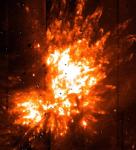 The Kleinmann Low Nebula
2.03.1999
The most active part of the Orion Nebular Cloud Complex is an area known as the Kleinmann-Low Nebula. There, a cluster of young and forming stars is embedded in a molecular cloud filled with dust.
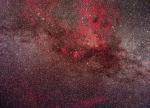 The Gum Nebula Supernova Remnant
7.11.2000
Because the Gum Nebula is the closest supernova remnant, it is actually hard to see. Spanning 40 degrees across the sky, the nebula is so large and faint it is easily lost in the din of a bright and complex background.
|
January February March April May June July August September October |
|||||||||||||||||||||||||||||||||||||||||||||||||