
|
Keyword: nebula
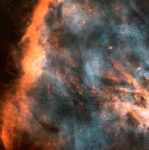 The Great Nebula in Orion
3.07.1995
The Great Nebula in Orion, M42, can be found on the night sky just below and to the left of the easily identifiable belt of three stars in the popular constellation Orion. This nebula is one of the closest stellar nurseries - where young stars are being formed even now.
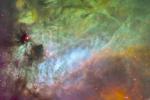 Elements of the Swan Nebula
11.08.2003
In the depths of the dark clouds of dust and molecular gas known as M17, stars continue to form. Also known as the Omega Nebula and Horseshoe Nebula, the darkness of M17's molecular clouds results from background starlight being absorbed by thick filaments of carbon-based smoke-sized dust.
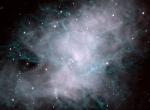 The Crab Nebula in Blue and White
11.07.2000
The Crab Nebula is a complex shell of expanding gas. The Crab Nebula formed from a star that was seen to explode in a supernova about 1000 years ago. This two color composite image taken with the WIYN 3.5-meter telescope shows in great detail filamentary structure of the glowing hydrogen gas.
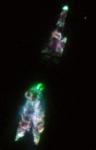 Emerging Planetary Nebula CRL 618
6.09.2000
CRL 618 may look to some like an Olympian declaring victory. Only a few hundred years ago, however, CRL 618 appeared as a relatively modest red giant star. Since then it has run out of core material to fuse and so has started to become a planetary nebula.
 Clusters and Nebulae of the Hexagon
4.04.2003
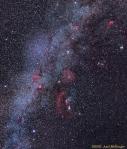
At first, the bright stars of the large asterism known as the (northern) Winter Hexagon might be hard to pick out in this gorgeous deep sky mosaic from December 2002. But placing your cursor...
 MWC 922: The Red Square Nebula
16.04.2007
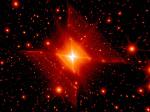
What could cause a nebula to appear square? No one is quite sure. The hot star system known as MWC 922, however, appears to be imbedded in a nebula with just such a shape. The above image combines infrared exposures from the Hale Telescope on Mt.
 The Orion Nebula from Subaru
2.02.1999
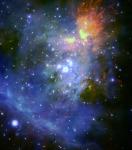
The Orion Nebula (M42) shows a host of treasures when viewed in infrared light. Some stars in the Trapezium, an open cluster of stars at the center, are only visible in infrared light. The orange feature above center is called the Kleinman-Low Nebula, and appears greatly affected by newly forming central star IRc2.
 Denizen of the Tarantula Nebula
7.04.1999
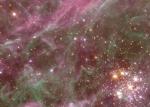
The star cluster at lower right, cataloged as Hodge 301, is a denizen of the Tarantula Nebula. An evocative nebula in the southern sky, the sprawling cosmic Tarantula is an energetic star forming region some 168,000 light-years distant in our neighboring galaxy the Large Magellanic Cloud.
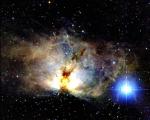 The Flame Nebula in Infrared
13.07.1999
What lights up the Flame Nebula? Fifteen hundred light years away towards the constellation of Orion lies a nebula which, from its glow and dark dust lanes, appears like a billowing fire. But fire, the rapid acquisition of oxygen, is not what makes this Flame glow.
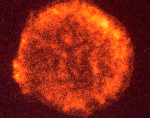 Tychos Supernova Remnant in X ray
7.03.1999
How often do stars explode? By looking at external galaxies, astronomers can guess that these events, known as a supernovae, should occur about once every 30 years in a typical spiral galaxy like our MilkyWay.
|
January February March April May June July August September October |
|||||||||||||||||||||||||||||||||||||||||||||||||