
|
Keyword: nebula
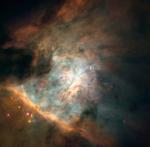 M42: A Mosaic of Orion's Great Nebula
22.05.1999
The Great Nebula in Orion, an immense, nearby starbirth region, is probably the most famous of all astronomical nebulae. Here, 15 pictures from the Hubble Space Telescope have been mosaicked to cover the inner 2.5 light years of the nebula and illustrate its diverse nature.
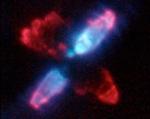 Shells in the Egg Nebula
20.05.1997
The Egg Nebula is taking a beating. Like a baby chick pecking its way out of an egg, the star in the center of the Egg Nebula is casting away shells of gas and dust as it slowly transforms itself into a white dwarf star.
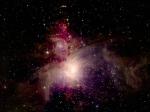 Orion Nebula: The 2MASS View
12.06.1998
Few astronomical sights excite the imagination like the nearby stellar nursery known as the Orion Nebula. The Nebula's glowing gas surrounds hot young stars at the edge of an immense interstellar molecular cloud only 1,500 light-years away.
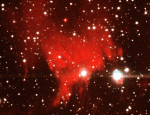 Nebula Nova Cygni Turns On
16.12.1996
Old photographs show no evidence of the above nebula. In 1992, a white dwarf star in Cygnus blew off its outer layers in a classical nova explosion: an event called Nova Cygni 1992. Light flooded the local interstellar neighborhood, illuminated this existing gas cloud, excited the existing hydrogen, and hence caused the red emission.
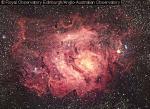 M8: The Lagoon Nebula
7.07.1998
The bright Lagoon Nebula is home to a diverse array of astronomical objects. Particularly interesting sources include a bright open cluster of stars and several energetic star-forming regions. The general red glow is caused by luminous hydrogen gas, while the dark filaments are caused by absorption by dense lanes of dust.
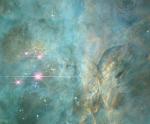 In the Center of the Trapezium
18.11.1997
Start with the constellation of Orion. Below Orion's belt is a fuzzy area known as the Great Nebula of Orion or M42. In this nebula is a bright star cluster known as the Trapezium, shown above. New stellar systems are forming there in gigantic globs of gas and dust known as Proplyds.
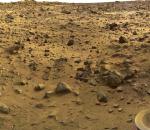 25 Years Ago: Vikings on Mars
21.07.2001
On July 20, 1976, NASA's Viking 1 lander become the first spacecraft to land on Mars, followed weeks later by its twin robot explorer, the Viking 2 lander. Operating on the Martian surface...
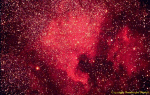 The North America Nebula
6.06.1996
Here's a familiar shape in an unfamiliar location! This emission nebula is famous partly because it resembles Earth's North American Continent. To the right of the North America Nebula is a less luminous Pelican Nebula. Let's be grateful that pelicans aren't really that large!
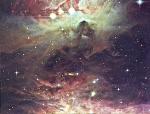 Reflections Of Orion
15.01.1999
The Orion Nebula and its surroundings present skygazers with a wondrous jumble of newborn stars, gas, and dust. Emission nebulae - glowing energized clouds of gas, and reflection nebulae - dust clouds shining by reflected starlight, abound at this photogenic cosmic location a mere 1,500 light-years or so away.
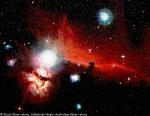 Orion's Horsehead Nebula
2.10.1996
The Horsehead Nebula is arguably the most famous nebula on the sky. It is visible as the black indentation to the red emission nebula seen just to the right of center of the above photograph. The bright star near the center is located in the belt of the familiar constellation of Orion.
|
January February March April May June July August September October |
|||||||||||||||||||||||||||||||||||||||||||||||||