
|
Keyword: nebula
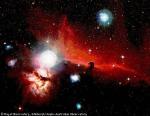 Orion's Horsehead Nebula
25.10.1997
The Horsehead Nebula is one of the most famous nebulae on the sky. It is visible as the black indentation to the red emission nebula seen just to the right of center of the above photograph. The bright star near the center is located in the belt of the familiar constellation of Orion.
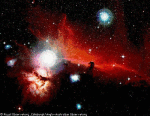 Orion's Horsehead Nebula
2.01.1999
The Horsehead Nebula is one of the most famous nebulae on the sky. It is visible as the black indentation to the red emission nebula seen just to the right of center of the above photograph. The bright star near the center is located in the belt of the familiar constellation of Orion.
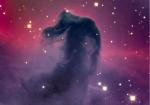 The Dark Horsehead Nebula
28.12.2000
While drifting through the cosmos, sculpted by stellar winds and radiation, this magnificent interstellar dust cloud has chanced to assume a recognizable shape. Fittingly named The Horsehead Nebula it is embedded in the immense complex of star forming gas and dust surrounding the Orion Nebula some 1,500 light-years distant.
 The Nebula And The Neutron Star
25.10.2000
The lonely RX J1856.5-3754 was formed from the collapsed core of an exploding star. At a distance of 180 light-years it is the closest known neutron star. More massive than...
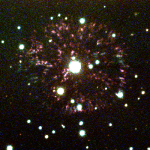 The Firework Nebula
4.07.1998
Imaged by the WIYN Telescope, the Firework Nebula is the result of a type of stellar explosion called a nova. In a nova, a nuclear detonation on the surface of a compact white dwarf star blasts away material that has been dumped on its surface by a companion star.
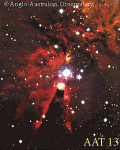 A Mysterious Cone Nebula
29.02.1996
Sometimes the simplest shapes are the hardest to explain. For example, the origin of the mysterious cone-shaped region located just below the center of the above picture remains a mystery. The dark region clearly contains much dust which blocks light from the emission nebula and open cluster NGC 2264 behind it.
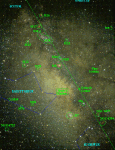 The Annotated Galactic Center
28.12.2001
The sky toward the center of our Galaxy is filled with a wide variety of celestial wonders. Many are easily visible with binoculars. Constellations near the galactic center include Sagittarius, Libra, Scorpius, Scutum, and Ophiuchus. Nebulae include Messier Objects M8, M16, M17, M20 and the Pipe Nebula.
 The Annotated Galactic Center
11.09.1999
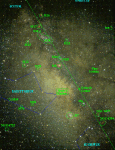
The sky toward the center of our Galaxy is filled with a wide variety of celestial wonders. Many are easily visible with binoculars. Constellations near the galactic center include Sagittarius, Libra, Scorpius, Scutum, and Ophiuchus. Nebulae include Messier Objects M8, M16, M17, M20 and the Pipe Nebula.
 Trifid Pillars and Jets
8.06.1999
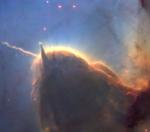
Dust pillars are like interstellar mountains. They survive because they are more dense than their surroundings, but they are being slowly eroded away by a hostile environment. Visible in the above picture...
 N159 and the Papillon Nebula
14.06.1999
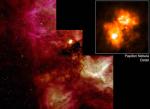
In a search for massive stars, the Hubble Space Telescope has peered into yet another spectacular region of star formation. This nebula, known as N159, spans over 150 light-years and is located in the neighboring Large Magellanic Cloud galaxy, about 170,000 light years distant.
|
January February March April May June July August September October |
|||||||||||||||||||||||||||||||||||||||||||||||||