
|
Keyword: nebula
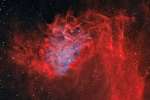 AE Aurigae and the Flaming Star Nebula
11.03.2011
AE Aurigae is the bright star below and left of center in this evocative portrait of IC 405, also known as the Flaming Star Nebula. Embedded in the cosmic cloud, the hot, variable O-type star energizes the glow of hydrogen along convoluted filaments of atomic gas, its blue starlight scattered by interstellar dust.
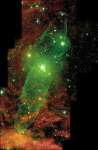 Ou4: A Giant Squid Nebula
18.07.2014
A mysterious, squid-like apparition, this nebula is very faint, but also very large in planet Earth's sky. In the mosaic image, composed with narrowband data from the 2.5 meter Isaac Newton Telescope, it spans some 2.5 full moons toward the constellation Cepheus.
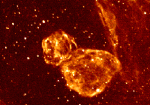 Colliding Supernova Remnants
2.10.1997
When a massive star exhausts its nuclear fuel it explodes. This stellar detonation, a supernova, propels vast amounts of starstuff outwards, initially at millions of miles per hour. For another 100,000 years...
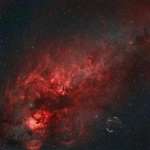 Nebulae in the Northern Cross
19.11.2010
Explore a beautiful and complex region of nebulae strewn along the plane of our Milky Way Galaxy in this widefield skyscape. The image emphasizes cosmic gas clouds in a 25 by 25 degree view centered on the Northern Cross, the famous asterism in the constellation Cygnus.
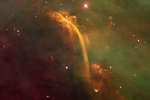 HH 222: The Waterfall Nebula
24.10.2011
What created the Waterfall Nebula? No one knows. The structure seen in the region of NGC 1999 in the Great Orion Molecular Cloud complex is one of the more mysterious structures yet found on the sky. Designated HH-222, the elongated gaseous stream stretches about ten light years and emits an unusual array of colors.
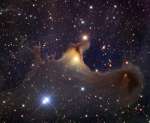 Ghost of the Cepheus Flare
31.10.2011
Spooky shapes seem to haunt this starry expanse, drifting through the night in the royal constellation Cepheus. Of course, the shapes are cosmic dust clouds faintly visible in dimly reflected starlight. Far from your...
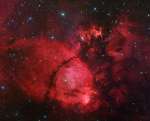 The Color of IC 1795
13.10.2011
This sharp cosmic portrait features glowing gas and obscuring dust clouds in IC 1795, a star forming region in the northern constellation Cassiopeia. Also cataloged as NGC 896, the nebula's remarkable details, shown...
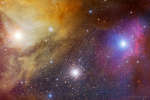 Antares and Clouds
17.04.2012
Antares is a huge star. In a class called red supergiant, Antares is about 850 times the diameter of our own Sun, 15 times more massive, and 10,000 times brighter. Antares is the brightest star in the constellation of Scorpius and one of the brighter stars in all the night sky.
 T Tauri and Hind s Variable Nebula
13.12.2007
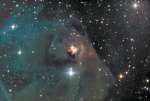
The orange star centered in this remarkable telescopic skyview is T Tauri, protoytpe of the class of T Tauri variable stars. Nearby it is a dusty yellow cosmic cloud historically known as Hind's Variable Nebula (aka NGC 1555/1554).
 M8: In the Center of the Lagoon Nebula
3.01.2001
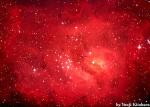
In the center of the Lagoon Nebula one finds glowing gas, star clusters, and dense knots of gas and dust just now forming stars. The young open cluster of stars, designated NGC 6523, can be seen in the center of the above image. These stars emit energetic light that ionizes the surrounding hydrogen gas.
|
January February March April May June July August September October |
|||||||||||||||||||||||||||||||||||||||||||||||||