
|
Keyword: Earth
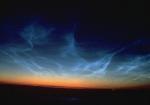 Noctilucent Clouds
19.06.2005
Sometimes it's night on the ground but day in the air. As the Earth rotates to eclipse the Sun, sunset rises up from the ground. Therefore, at sunset on the ground, sunlight still shines on clouds above.
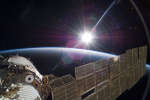 Bright Sun and Crescent Earth from the Space Station
30.11.2009
This was just one more breathtaking view from the International Space Station. The Sun, a crescent Earth, and the long arm of a solar panel were all visible outside a window when the Space Shuttle Atlantis visited the orbiting outpost last week. Reflections from the window and hexagonal lens flares from the camera are superposed.
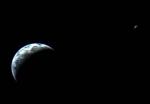 Nozomi: Earth and Moon
4.09.1998
Japan launched its first mission to orbit Mars, Nozomi (Hope), on July 3rd from the Kagoshima Space Center on the island of Kyushu. Nozomi's goal is to explore the Martian atmosphere and magnetic field as well as regions of the planet's surface and moons.
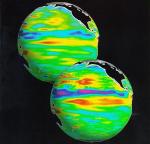 El Nino Water Rhythm
13.01.1998
This year's El Niño is the strongest ever recorded. The large amount of warm water in the Pacific Ocean near the equator is causing unusual weather all over planet Earth.
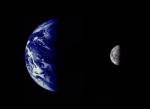 The Earth and Moon Planetary System
15.10.2001
How similar in size are the Earth and the Moon? A dramatic visual answer to this question is found by combining photographs taken by the Mariner 10 spacecraft that headed out toward Venus and Mercury in 1973.
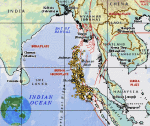 The Powerful Sumatra Andaman Islands Earthquake
2.03.2005
December's 9.0 earthquake has likely shortened Earth's day by about three microseconds and may also have tweaked Earth's rotational wobble. The megathrust earthquake occurred as the Indian tectonic plate slid further beneath the Burma tectonic plate.
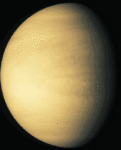 Venus: Earth's Sister Planet
15.08.1995
This picture in visible light was taken by the Galileo spacecraft. Venus is very similar to Earth in size and mass - and so is sometimes referred to as Earth's sister planet - but Venus has a quite different climate.
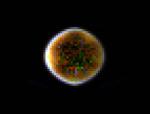 Gamma Ray Earth
31.03.2005
The pixelated planet above is actually our own planet Earth seen in gamma rays - the most energetic form of light. In fact, the gamma rays used to construct this view pack over 35 million electron volts (MeV) compared to a mere two electron volts (eV) for a typical visible light photon.
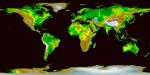 The Highs and Lows of Earth
25.09.2001
What's up on planet Earth? A truly global answer has now been created by the Global Land One-km Base Elevation (GLOBE) Project. Pictured above is the best digital elevation map yet created...
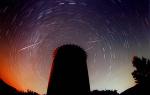 Leonids Above Torre de la Guaita
23.11.1999
The 1999 Leonids Meteor Shower came to a tremendous crescendo. Observers in Europe observed a sharp peak in the number of meteors visible around 0210 UTC during the early morning hours of November 18. Meteor counts then exceeded 1000 per hour - the minimum needed to define a true meteor storm.
|
January February March April May June July August September October |
|||||||||||||||||||||||||||||||||||||||||||||||||