
|
Keyword: emission nebula
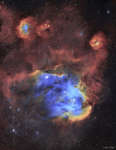 IC 2944: The Running Chicken Nebula
20.04.2020
To some, it looks like a giant chicken running across the sky. To others, it looks like a gaseous nebula where star formation takes place. Cataloged as IC 2944, the Running Chicken Nebula spans about 100 light years and lies about 6,000 light years away toward the constellation of the Centaur (Centaurus).
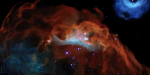 Journey into the Cosmic Reef
18.05.2020
What would you see if you could fly into the Cosmic Reef? The nebular cloud NGC 2014 appear to some like an ocean reef that resides in the sky, specifically in the LMC, the largest satellite galaxy of our Milky Way Galaxy.
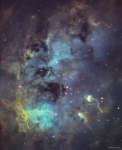 The Tadpoles of IC 410
18.06.2020
This telescopic close-up shows off the central regions of otherwise faint emission nebula IC 410, captured under backyard suburban skies with narrowband filters. It also features two remarkable inhabitants of the cosmic pond of gas and dust. Below and right of center are the tadpoles of IC 410.
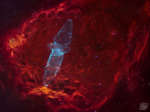 Ou4: A Giant Squid in a Flying Bat
7.10.2020
A very faint but very large squid-like nebula is visible in planet Earth's sky -- but inside a still larger bat. The Giant Squid Nebula cataloged as Ou4, and Sh2-129 also known as the Flying Bat Nebula, are both caught in this cosmic scene toward the royal royal constellation Cepheus.
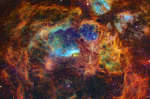 NGC 6357: The Lobster Nebula
28.10.2020
Why is the Lobster Nebula forming some of the most massive stars known? No one is yet sure. Cataloged as NGC 6357, the Lobster Nebula houses the open star cluster Pismis 24 near its center -- a home to unusually bright and massive stars.
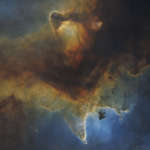 The Central Soul Nebula Without Stars
10.11.2020
This cosmic close-up looks deep inside the Soul Nebula. The dark and brooding dust clouds near the top, outlined by bright ridges of glowing gas, are cataloged as IC 1871. About 25 light-years across, the telescopic field of view spans only a small part of the much larger Heart and Soul nebulae.
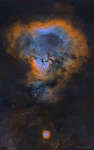 NGC 7822: Cosmic Question Mark
13.10.2021
It may look like a huge cosmic question mark, but the big question really is how does the bright gas and dark dust tell this nebula's history of star formation. At the edge...
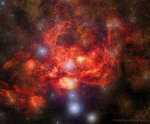 NGC 6357: The Lobster Nebula
1.11.2022
Why is the Lobster Nebula forming some of the most massive stars known? No one is yet sure. Cataloged as NGC 6357, the Lobster Nebula houses the open star cluster Pismis 24 near its center -- a home to unusually bright and massive stars.
 APOD: 2025 June 26 Б The Seagull Nebula
26.06.2025
An interstellar expanse of glowing gas and obscuring dust presents a bird-like visage to astronomers from planet Earth, suggesting its popular moniker, the Seagull Nebula. This broadband portrait of the cosmic bird covers...
 NGC 6164: A Dragon s Egg
24.04.2025
Beautiful emission nebula NGC 6164 was created by a rare, hot, luminous O-type star, some 40 times as massive as the Sun. Seen at the center of the cosmic cloud, the star is a mere 3 to 4 million years old.
|
January February March April May June July August September October |
|||||||||||||||||||||||||||||||||||||||||||||||||