
|
Keyword: emission nebula
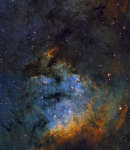 NGC 7822 in Cepheus
22.10.2010
Pillars of gas, dust, and young, hot stars seem to fill the gaping maw of NGC 7822. At the edge of a giant molecular cloud toward the northern constellation Cepheus, the glowing star forming region lies about 3,000 light-years away. Within the nebula, bright edges and dark shapes are highlighted in this colorful skyscape.
 Hydrogen Trifid
28.08.1998
Clouds of glowing hydrogen gas mingle with dark dust lanes in the Trifid Nebula, a star forming region in the constellation Sagittarius. In this and other similar emission nebulae, energetic ultraviolet light from an embedded hot young star strips electrons from the surrounding hydrogen atoms.
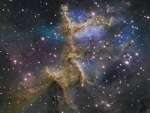 Central IC 1805
26.07.2008
Cosmic clouds seem to form fantastic shapes in the central regions of emission nebula IC 1805. Of course, the clouds are sculpted by stellar winds and radiation from massive hot stars in the nebula's newborn star cluster (aka Melotte 15).
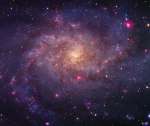 Bright Nebulae in M33
17.10.2009
Gorgeous spiral galaxy M33 seems to have more than its fair share of bright emission nebulae. In fact, narrow-band and broad-band image data are combined in this beautifully detailed composite to trace the reddish emission nebulae, star forming HII regions, sprawling along loose spiral arms that wind toward the galaxy's core.
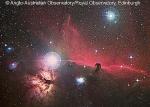 Orion's Horsehead Nebula
27.08.2000
The Horsehead Nebula is one of the most famous nebulae on the sky. It is visible as the black indentation to the red emission nebula seen just to the right of center of the above photograph. The bright star near the center is located in the belt of the familiar constellation of Orion.
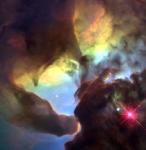 Twistin By The Lagoon
25.09.1999
The awesome spectacle of starbirth produces extreme stellar winds and intense energetic starlight -- bombarding dusty molecular clouds inside the Lagoon Nebula (M8). At least two long funnel shaped clouds, each roughly half a light-year long, have apparently been formed by this activity.
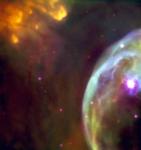 Close Up of the Bubble Nebula
18.11.1998
It's the bubble versus the cloud. NGC 7635, the Bubble Nebula, is being pushed out by the stellar wind of massive central star BD+602522. Next door, though, lives a giant molecular cloud, visible above to the upper left.
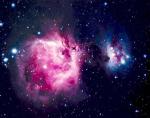 The Great Nebula in Orion
27.01.1998
The Great Nebula in Orion can be found just below and to the left of the easily identifiable belt of three stars in the popular constellation Orion. This fuzzy patch contains one of the closest stellar nurseries, lying at a distance of about 1500 light years.
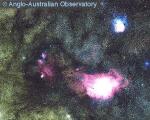 The Sky Towards Sagittarius
7.09.1998
A variety of stars and nebulae can be found towards the constellation of Sagittarius. Dense fields of stars laced with dark lanes of dust crowd this region only a few degrees from the center of our Galaxy.
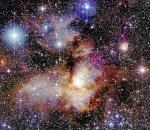 Star-Forming Region RCW38 from 2MASS
17.07.2002
The star cluster in RCW38 was hiding. Looking at the star forming region RCW38 will not normally reveal most of the stars in this cluster. The reason is that the open cluster is so young that it is still shrouded in thick dust that absorbs visible light.
|
January February March April May June July August September October |
|||||||||||||||||||||||||||||||||||||||||||||||||