
|
Keyword: emission nebula
 APOD: 2024 May 1 Б IC 1795: The Fishhead Nebula
1.05.2024
To some, this nebula looks like the head of a fish. However, this colorful cosmic portrait really features glowing gas and obscuring dust clouds in IC 1795, a star forming region in the northern constellation Cassiopeia.
 APOD: 2024 April 24 Б Dragons Egg Bipolar Emission Nebula
24.04.2024
How did a star form this beautiful nebula? In the middle of emission nebula NGC 6164 is an unusually massive star. The central star has been compared to an oyster's pearl and an egg protected by the mythical sky dragons of Ara.
 APOD: 2025 September 10 Б The Great Lacerta Nebula
10.09.2025
It is one of the largest nebulas on the sky -- why isn't it better known? Roughly the same angular size as the Andromeda Galaxy, the Great Lacerta Nebula can be found toward the constellation of the Lizard (Lacerta).
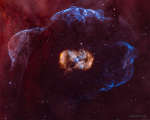 NGC 6164: Dragons Egg Nebula and Halo
26.12.2022
The star at the center created everything. Known as the Dragon's Egg, this star -- a rare, hot, luminous O-type star some 40 times as massive as the Sun -- created not only the complex nebula (NGC 6164) that immediately surrounds it, but also the encompassing blue halo.
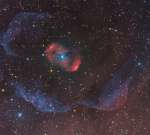 A Halo for NGC 6164
22.05.2014
Beautiful emission nebula NGC 6164 was created by a rare, hot, luminous O-type star, some 40 times as massive as the Sun. Seen at the center of the cosmic cloud, the star is a mere 3 to 4 million years old.
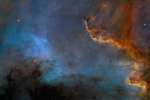 Along the Cygnus Wall
3.07.2014
The prominent ridge of emission featured in this vivid skyscape is known as the Cygnus Wall. Part of a larger emission nebula with a distinctive shape popularly called The North America Nebula, the ridge spans about 10 light-years along an outline that suggests the western coast of Mexico.
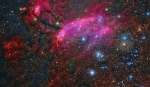 IC 4628: The Prawn Nebula
9.12.2016
South of Antares, in the tail of the nebula-rich constellation Scorpius, lies emission nebula IC 4628. Nearby hot, massive stars, millions of years young, irradiate the nebula with invisible ultraviolet light, stripping electrons from atoms. The electrons eventually recombine with the atoms to produce the visible nebular glow, dominated by the red emission of hydrogen.
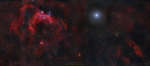 Seagull to Sirius
15.12.2016
This broad, beautiful mosaic spans almost 20 degrees across planet Earth's sky. The nebula-rich region lies near the edge of the Orion-Eridanus supperbubble, filled with looping, expanding shells of gas and dust embedded in molecular clouds near the plane of the Milky Way Galaxy.
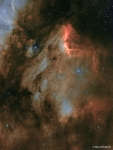 IC 5070: A Dusty Pelican in the Swan
19.11.2016
The recognizable profile of the Pelican Nebula soars nearly 2,000 light-years away in the high flying constellation Cygnus, the Swan. Also known as IC 5070, this interstellar cloud of gas and dust...
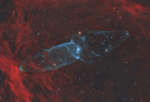 Ou4: The Giant Squid Nebula
12.10.2022
A mysterious squid-like cosmic cloud, this nebula is very faint, but also very large in planet Earth's sky. In the image, composed with 30 hours of narrowband image data, it spans nearly three full moons toward the royal constellation Cepheus.
|
January February March April May June July August September October |
|||||||||||||||||||||||||||||||||||||||||||||||||