
|
Keyword: meteor
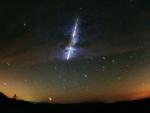 1998 Leonid Fireball
12.11.1999
Will this be the year? Last year's Leonid meteor shower did not produce the meteor storm many had hoped for. Still, it put on a dazzling show with many bright fireball meteors. For example, this Leonid fireball, photographed through light clouds, eerily flashed across the skies of Monteromano, Italy on November 17, 1998.
 Leonids 1998: A Safe Meteor Storm
16.11.1998
You're in no danger. During the meteor storm occurring tonight and tomorrow, thousands of bits of ice and rock will likely rain onto the Earth. Few, if any, will hit the ground. Touted as potentially the most active meteor shower since 1966, the Leonids of 1998 will be tracked by observers the world over.
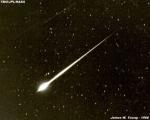 A Leonid Fireball From 1966
13.11.1998
This bright fireball meteor was photographed from Table Mountain Observatory during the peak of the annual Leonid meteor shower on November 17, 1966. That was a good year for Leonid meteor watchers - a meteor "storm" was produced as the Earth swept through a dense swarm of dusty debris from the tail of comet Tempel-Tuttle.
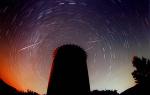 Leonids Above Torre de la Guaita
23.11.1999
The 1999 Leonids Meteor Shower came to a tremendous crescendo. Observers in Europe observed a sharp peak in the number of meteors visible around 0210 UTC during the early morning hours of November 18. Meteor counts then exceeded 1000 per hour - the minimum needed to define a true meteor storm.
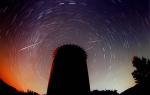 Leonids Above Torre de la Guaita
14.11.2004
The 1999 Leonids Meteor Shower came to an impressive crescendo. Observers in Europe observed a sharp peak in the number of meteors visible around 0210 UTC during the early morning hours of November 18. Meteor counts then exceeded 1000 per hour - the minimum needed to define a true meteor storm.
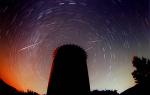 Leonids Above Torre de la Guaita
26.11.2000
Last year, the 1999 Leonids Meteor Shower came to a tremendous crescendo. Observers in Europe observed a sharp peak in the number of meteors visible around 0210 UTC during the early morning hours of November 18. Meteor counts then exceeded 1000 per hour - the minimum needed to define a true meteor storm.
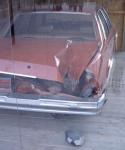 The Car, the Hole, and the Peekskill Meteorite
19.11.2006
The Peekskill meteor of 1992 was captured on 16 independent videos and then struck a car. Documented as brighter than the full Moon, the spectacular fireball crossed parts of several US states during its 40 seconds of glory before landing in Peekskill, New York.
 Comet and Meteor
5.01.2009
This meteor streaking toward the horizon through the early morning sky of January 3rd is from the annual Quadrantid meteor shower. Aligned with the shower's radiant point high in the north (off the top of the view), the meteor trail passes to the right of bright bluish star Beta Scorpii.
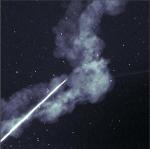 Leonid Glowworm
28.04.2000
Recent Leonid meteor showers have been rich in bright fireball meteors which leave lingering trails stretching across the night sky. These trails, or persistent trains, are mysteriously self-luminescent and do not shine by reflected light.
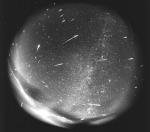 Leonids from Leo
8.12.1998
Is Leo leaking? Leo, the famous sky constellation visible on the left of the above all-sky photograph, appears to be the source of all the meteors seen in this year's Leonids Meteor Shower.
|
January February March April May June July August September October |
|||||||||||||||||||||||||||||||||||||||||||||||||