
|
Keyword: meteor
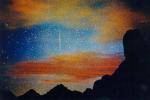 Leonid Sunrise
17.11.2000
Such beautiful things begin as grains of sand. Locked in an oyster a granule grows into an iridescent pearl, lustrous and lovely to behold. While hurtling through the atmosphere at 70 kilometers per second, a cosmic sand grain becomes an awe-inspiring meteor, its transient beauty displayed for any who care to watch.
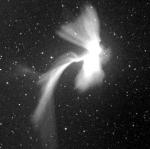 A Leonid Meteor Explodes
23.11.1998
Click on the above image and watch a Leonid meteor explode. The tremendous heat generated by the collision of a small sand-bit moving at 70 kilometers/second with the Earth's upper atmosphere causes the rock-fragment to heat up, glow brightly, and disintegrate.
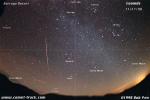 An Annotated Leonid
30.11.1998
The 1998 Leonids Meteor Shower was perhaps the most photographed meteor event in history. Patient observers saw bright meteors streak across dark skies every few minutes, frequently leaving fading trails stretching across the sky. High above the Anza-Borrego Desert, a meteor was photographed streaking up from the radiant constellation of the Leonids: Leo.
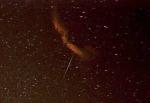 Twisting Meteor Train
27.11.1998
Blazing through the sky at 70 kilometers per second, 100 kilometers or so above planet Earth, many bright Leonid meteors left behind a persistent, smoke-like trail of glowing, hot, ionized gas. Twisting in high altitude winds, these trails or trains typically were visible for many minutes.
 A Strange Streak Imaged in Australia
7.12.2004
Meteor experts don't think it's a meteor. Atmospheric scientists don't think it's lightning. The photographer insists that the streak and flash on the above image has not been created digitally. So what is it? Nobody is sure.
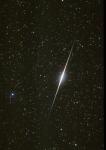 Iridium 52: Not A Meteor
22.10.1999
While hunting for meteors in the night sky above the White Mountains near Bishop, California, astrophotographer James Young instead captured this brilliant celestial apparition. Recorded near twilight on August 13, the bright streak is not the flash of a meteor trail but sunlight glinting from a satellite.
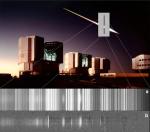 The Spectrum of A Meteor
12.08.2004
Chasing the brief flash of a meteor trail across the sky with a very large telescope is a nearly impossible task. But on May 12, 2002, astronomers got lucky, as a bright meteor chanced across the narrow slit of their spectrograph at the Paranal Observatory.
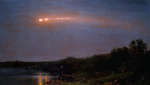 The Meteor of 1860
22.07.2010
Frederic Church (1826-1900), American landscape painter of the Hudson River School, painted what he saw in nature. And on July 20th, 1860, he saw a spectacular string of fireball meteors cross the Catskill evening sky, an extremely rare Earth-grazing meteor procession.
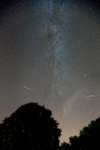 Night of the Perseids
14.08.2010
On the night of August 12, from moonset until dawn was a good time to see meteors. Enthusiasts watched as comet dust rained on planet Earth, streaking through dark skies during the annual Perseid Meteor Shower.
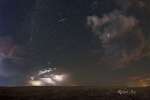 Perseid Storm
21.08.2010
Storms on the distant horizon and comet dust raining through the heavens above are combined in this alluring nightscape. The scene was recorded in the early hours of August 13 from the Keota Star Party site on the Pawnee National Grasslands of northeastern Colorado, USA.
|
January February March April May June July August September October |
|||||||||||||||||||||||||||||||||||||||||||||||||