
|
Keyword: planet
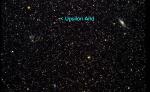 Where is Upsilon Andromedae
22.04.1999
Astronomers recently announced the detection of three large planets orbiting the star Upsilon Andromedae - the first planetary system known to orbit a normal star other than our Sun. These planets were not directly photographed but found through a Doppler technique developed to use large telescopes to search nearby stars for wobbling planetary signatures.
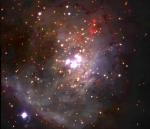 Free Floating Planets In Orion
31.03.2000
This false-colour image of the young Trapezium star cluster in the Orion Nebula was made with an infrared camera at wavelengths about twice as long as visible light. The infrared data are part...
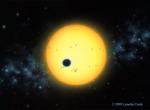 In the Shade of a Historic Planet
15.11.1999
For the first time, astronomers have recovered independent evidence that distant planetary systems exist. Last Friday, a team led by G. W. Henry (Tenn. State) and G. Marcy (UC Berkeley) announced the discovery of a shadow of a planet crossing a distant star.
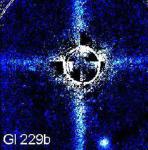 Brown Dwarf Gliese 229B
24.03.1999
The spot near the bottom is an image of an unusual type of object: a brown dwarf. A brown dwarf is sometimes called a "failed star" because it does not have enough mass to shine by nuclear fusion.
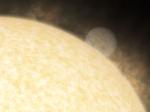 Light from a Extra Solar Planet
5.04.2005
Light emitted by a planet far beyond our Solar System has been identified for the first time. The planet, illustrated in the above drawing, had its light detected by comparing the brightness of only...
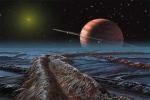 Other Worlds and HD 38529
10.08.2000
After the latest round of discovery announcements, the list of known worlds of distant suns has grown to 50. While extrasolar planet discoveries are sure to continue, none - so far - points clearly to another planetary system like our own. Take, for example, the newly discovered parent star HD38529.
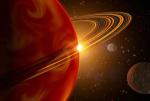 Saturn-Sized Worlds Discovered
30.03.2000
The last decade saw the profound discovery of many worlds beyond our solar system, but none analogs of our home planet Earth. Exploiting precise observational techniques, astronomers inferred the presence of well over two dozen extrasolar planets, most nearly as massive as gas giant Jupiter or more, in close orbits around sun-like stars.
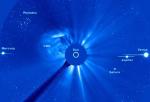 Pleiades, Planets, And Hot Plasma
24.05.2000
Bright stars of the Pleiades, four planets, and erupting solar plasma are all captured in this spectacular image from the space-based SOlar and Heliospheric Observatory (SOHO). In the foreground of the 15 degree wide field of view, a bubble of hot plasma, called a Coronal Mass Ejection (CME)
 March of the Planets
25.03.1999
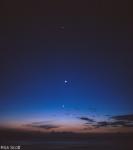
This March stargazers have been treated to eye-catching formations of bright planets in western evening skies. On March 3rd, looking toward a beautiful sunset from a beach on the Hawaiian isle of Maui, photographer Rick Scott recorded this fleeting, four-planet "hockey stick" array.
 Kepler Discovers How Planets Move
6.06.1999
Johannes Kepler used simple mathematics to describe how planets move. Kepler was an assistant to the most accurate astronomical observer of the time, Tycho Brahe. Kepler was able to use Brahe's data...
|
January February March April May June July August September |
|||||||||||||||||||||||||||||||||||||||||||||||||