
|
Keyword: Io
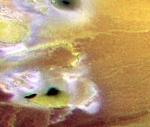 Calderas And Cliffs Near Io's South Pole
27.04.2000
Braving intense radiation belts, the Galileo spacecraft once again flew past the surface of Jupiter's moon Io (sounds like EYE-oh) on February 22. Combining high resolution black and white images from that flyby...
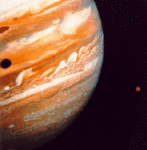 Jupiter, Io, and Ganymede's Shadow
13.10.1995
Jupiter, the solar system's largest planet, is seen here next to Io, its closest Galilean moon. On the cloud tops of Jupiter near the left edge of the picture can be seen a dark circular spot which is caused by the shadow of Jupiter's largest moon Ganymede.
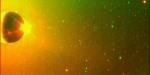 Io's Sodium Cloud
28.04.1997
Io has its own cloud. Jupiter's most active moon is visible on the left of the above false-color photograph, with its left side illuminated by sunlight. But what is happening on Io's right side? Here a plume of gas from the active volcano Prometheus also reflects sunlight.
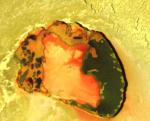 Looking Into an Io Volcano
27.03.2002
What would it look like to peer into one of the volcanoes currently active on Jupiter's moon Io? The caldera of Tupan Patera, named after a Brazilian thunder god, reveals itself...
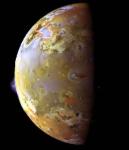 Io: The Prometheus Plume
22.06.2002
Two sulfurous eruptions are visible on Jupiter's volcanic moon Io in this color composite Galileo image. On the left, over Io's limb, a new bluish plume rises about 86 miles above the surface of a volcanic caldera known as Pillan Patera.
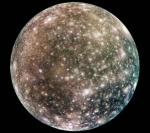 Callisto Full Face
20.01.2002
Callisto's surface shows its age. While probably formed at the same time as Io, the difference between the surfaces of these two moons of Jupiter could hardly be greater. Io's surface is young, shows practically no impact craters, and is continually being repaved by the lava exploding from its many large volcanoes
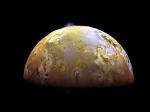 Io: The Prometheus Plume
11.02.2007
What's happening on Jupiter's moon Io? Two sulfurous eruptions are visible on Jupiter's volcanic moon Io in this color composite image from the robotic Galileo spacecraft that orbited Jupiter from 1995 to 2003.
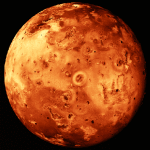 Io: A Volcanic Moon
3.08.1995
In 1610, Galileo turned his telescope to the heavens and discovered that the planet Jupiter had four bright moons. The innermost of these Galilean moons, Io, turned out to be one of the most exotic objects in the solar system.
 Io: The Prometheus Plume
18.08.1997
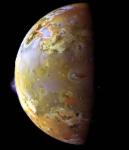
Two sulfurous eruptions are visible on Jupiter's volcanic moon Io in this color composite Galileo image. On the left, over Io's limb, a new bluish plume rises about 86 miles above the surface of a volcanic caldera known as Pillan Patera.
 Dark Volcano Active on Io
10.11.1997
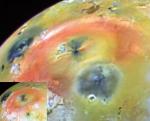
The surface of Io is changing even as we watch. The inset frame of Jupiter's most active moon was taken by the robot spacecraft Galileo in April. Just last month the larger image was taken. The new large black spot reveals that a volcano named Pillan Patera has been erupting during the interim.
|
January February March April May June July August September October |
|||||||||||||||||||||||||||||||||||||||||||||||||