
|
Keyword: dust
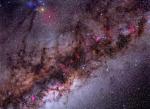 Our Galaxy in Stars, Gas, and Dust
28.09.2003
The disk of our Milky Way Galaxy is home to hot nebulae, cold dust, and billions of stars. The red nebulae visible in the above contrast-enhanced picture are primarily emission nebulae, glowing clouds of hydrogen gas heated by nearby, bright, young stars.
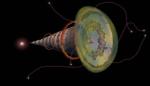 Cosmic Rays and Supernova Dust
18.06.1998
Cosmic Rays are celestial high energy particles traveling at nearly the speed of light, which constantly bombard the Earth. Discovered during high altitude balloon flights in 1912 their source has been a long standing mystery.
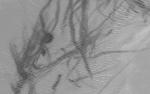 Martian Dust Devil Trails
16.03.2000
Who's been marking up Mars? This portion of a recent high-resolution picture from the orbiting Mars Global Surveyor spacecraft shows twisting dark trails criss-crossing a relatively flat rippled region about 3 kilometers wide on the martian surface.
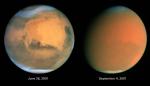 Mars Engulfed
17.10.2001
For months now, Mars has been engulfed by a great dust storm, the biggest seen raging across the Red Planet in decades. As a result, these two Hubble Space Telescope storm watch images from late June and early September offer dramatically contrasting views of the martian surface.
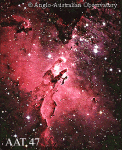 M16: Dust and an Open Cluster
31.10.1995
The photogenic M16 shown above is composed of a young star cluster and a spectacular emission nebulae lined with distinct regions of interstellar dust. Most of the stars in the cluster can be seen offset just above and to the right of the photograph's center.
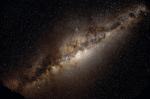 The Milky Way in Stars and Dust
4.10.2005
The disk of our Milky Way Galaxy is home to hot nebulae, cold dust, and billions of stars. This disk can be seen from a dark location on Earth as a band of diffuse light across the sky.
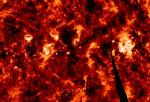 The Frothy Milky Way
9.10.1999
Astronomers have discovered that looking at dust along the plane of our Milky Way Galaxy is a bit like looking into a frothy glass of beer. The dust between stars in our galaxy appears...
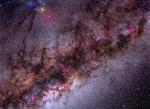 Our Galaxy in Stars, Gas, and Dust
27.09.1999
The disk of our Milky Way Galaxy is home to hot nebulae, cold dust, and billions of stars. The red nebulae visible in the above contrast-enhanced picture are primarily emission nebulae, glowing clouds of hydrogen gas heated by nearby, bright, young stars.
 Fractal Interstellar Dust Up Close
3.01.1998
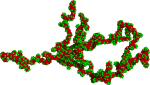
Our universe is a very dusty place. Dust usually shows its presence by blocking out light emitted from stars or nebulae behind it, sometimes creating the illusion of a horse's head or a sombrero hat. But nobody really knows what a typical interstellar dust grain looks like.
 A Tail of Two Hemispheres
31.01.2007
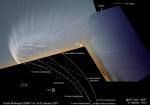
By January 19/20 Comet McNaught's magnificent dust tail stretched for about 150 million kilometers (~1 AU), requiring images from both southern and northern hemispheres of planet Earth to take it all in.
|
January February March April May June July August September October |
|||||||||||||||||||||||||||||||||||||||||||||||||