
|
Keyword: universe
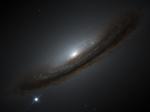 Rumors of a Strange Universe
24.12.2006
Eight years ago results were first presented indicating that most of the energy in our universe is not in stars or galaxies but is tied to space itself. In the language of cosmologists, a large cosmological constant is directly implied by new distant supernovae observations.
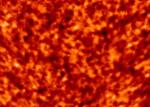 BOOMERANG Images The Early Universe
3.05.2000
Drifting through the stratosphere above Antarctica in late 1998, the balloon-borne BOOMERANG telescope peered into the cosmos at millimeter wavelengths. The blotchy structures it detected are seen above in the sharpest yet picture of the universe at an early age, perhaps a mere 300,000 years old.
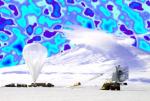 The Race to Reveal Our Universe
9.05.2000
A race is underway to understand our universe through background radiation produced during its infancy. Observationally, increasingly accurate balloon experiments are pressing to beat future space-faring satellites to definitive measurements of universe-determining spot characteristics of the cosmic microwave background (CMB) radiation.
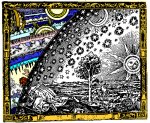 The Millennium that Defines Universe
1.01.2000
Welcome to the millennial year at the threshold of millennium three. During millennium two, humanity continually redefined its concept of "Universe": first as spheres centered on the Earth, in mid-millennium as the Solar System, a few centuries ago as the Galaxy, and within the last century as the matter emanating from the Big Bang.
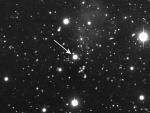 QSO H1821 643 Indicates a Universe Filled with Hydrogen
16.05.2000
A quasar slightly depleted of a specific color of light may indicate that our universe is filled with massive amounts of ionized hydrogen. Light from QSO H1821+643, pictured above, comes to us from about a quarter of the way across the visible universe.
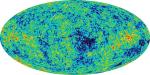 WMAP Resolves the Universe
25.09.2005
Analyses of a new high-resolution map of microwave light emitted only 380,000 years after the Big Bang appear to define our universe more precisely than ever before. The eagerly awaited results announced last year from the orbiting Wilkinson Microwave Anisotropy Probe resolve several long-standing disagreements in cosmology rooted in less precise data.
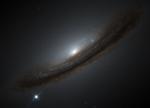 Supernova 1994D and the Unexpected Universe
12.03.2000
Far away, long ago, a star exploded. Supernova 1994D, visible as the bright spot on the lower left, occurred in the outskirts of disk galaxy NGC 4526. Supernova 1994D was not of interest for how different it was, but rather for how similar it was to other supernovae. In fact, the
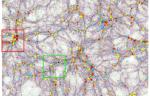 Finding Dark Matter
19.12.2001
Where is dark matter? Galaxies rotate and move in clusters as if a tremendous amount of unseen matter is present. But does dark matter exist in the greater universe too -- and if so, where? The answer can be found by comparing the distribution of galaxies observed with numerical simulations.
 The SDSS 3D Universe Map
28.10.2003
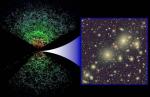
The latest map of the cosmos again indicates that dark matter and dark energy dominate our universe. The Sloan Digital Sky Survey (SDSS) is on its way to measuring the distances to over one million galaxies.
 The Known Universe
20.01.2010
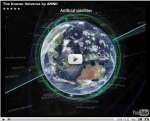
What would it look like to travel across the known universe? To help humanity visualize this, the American Museum of Natural History has produced a modern movie featuring many visual highlights of such a trip.
|
January February March April May June July August September October |
|||||||||||||||||||||||||||||||||||||||||||||||||