
|
Keyword: infrared
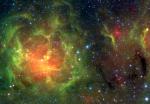 Infrared Trifid
13.01.2005
The Trifid Nebula, aka M20, is easy to find with a small telescope, a well known stop in the nebula rich constellation Sagittarius. But where visible light pictures show the nebula divided into three parts by dark, obscuring dust lanes, this penetrating infrared image reveals filaments of luminous gas and newborn stars.
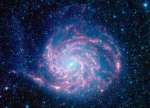 Spitzer s M101
30.12.2009
Big, beautiful spiral galaxy M101 is one of the last entries in Charles Messier's famous catalog, but definitely not one of the least. About 170,000 light-years across, this galaxy is enormous, almost twice the size of our own Milky Way Galaxy.
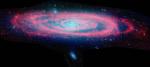 Infrared Andromeda
21.07.2007
This wide, detailed Spitzer Space Telescope view features infrared light from dust (red) and old stars (blue) in Andromeda, a massive spiral galaxy a mere 2.5 million light-years away. In fact, with over twice the diameter of our own Milky Way, Andromeda is the largest nearby galaxy.
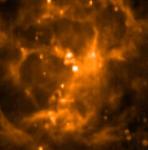 Infrared Trifid
28.08.1997
The Trifid nebula (M20) is a bright star forming region in Sagittarius, 5000 light years from Earth. In visible light, the interstellar gas cloud is crossed by dark, obscuring dust lanes which roughly divide the glowing emission nebula into three major parts.
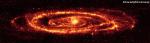 The Andromeda Galaxy in Infrared
20.10.2005
What is the Andromeda galaxy really like? To find out, astronomers looked at our largest galactic neighbor in a different light: infrared. Astronomers trained the orbiting Spitzer Space Telescope at the Messier monster (M31) for over 18 hours, creating a mosaic that incorporated 11,000 separate exposures.
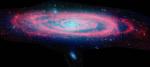 Infrared Andromeda
9.06.2006
This wide, detailed Spitzer Space Telescope view features infrared light from dust (red) and old stars (blue) in Andromeda, a massive spiral galaxy a mere 2.5 million light-years away. In fact, with over twice the diameter of our own Milky Way, Andromeda is the largest nearby galaxy.
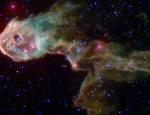 Inside The Elephant's Trunk
9.04.2005
In December of 2003, the world saw spectacular first images from the Spitzer Space Telescope, including this penetrating interior view of an otherwise opaque dark globule known as the Elephant's Trunk Nebula. Seen...
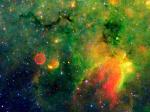 A Galactic Star Forming Region in Infrared
24.09.2007
How do stars form? To help study this complex issue, astronomers took a deep image in infrared light of an active part of our Milky Way Galaxy where star formation is rampant. In IRDC G11.11-0
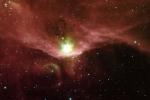 Sharpless 140
20.05.2004
Three young, massive stars will eventually emerge from this natal cloud of dust and gas, but their presence is already revealed in this false-color image from the Spitzer Space Telescope. The picture offers...
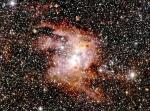 Giant Emission Nebula NGC 3603 in Infrared
14.08.2002
NGC 3603 is the largest region of glowing gas in our Milky Way galaxy. Spanning over 20 light years across, the giant emission nebula (HII region) is home to a massive star cluster, thick dust pillars, and a star about to explode.
|
January February March April May June July August September October |
|||||||||||||||||||||||||||||||||||||||||||||||||