
|
Keyword: infrared
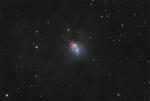 Dusty NGC 1300
6.10.2006
Dusty NGC 1333 is seen in visible light as a reflection nebula, dominated by bluish hues characteristic of starlight reflected by dust. But at longer infrared wavelengths, the interstellar dust itself glows. Moving your...
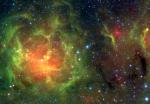 Infrared Trifid
7.07.2007
The Trifid Nebula, aka Messier 20, is easy to find with a small telescope, a well known stop in the nebula rich constellation Sagittarius. But where visible light pictures show the nebula divided into three parts by dark, obscuring dust lanes, this penetrating infrared image reveals filaments of glowing dust clouds and newborn stars.
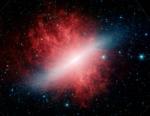 Smoke from the Cigar Galaxy
14.04.2006
Very bright in infrared light, well-known starburst galaxy M82's popular name describes its suggestive shape seen at visible wavelengths - The Cigar Galaxy. Ironically, M82's fantastic appearance in this Spitzer Space Telescope image...
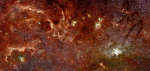 The Galactic Core in Infrared
7.01.2009
What's happening at the center of our Milky Way Galaxy? To help find out, the orbiting Hubble and Spitzer space telescopes have combined their efforts to survey the region in unprecedented detail in infrared light.
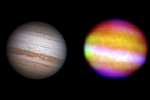 Jupiter from the Stratosphere
3.06.2010
SOFIA, the Stratospheric Observatory for Infrared Astronomy, captured its "first light" images on May 26, from an altitude of 35,000 feet. While flying above most of planet Earth's infrared-absorbing water vapor, SOFIA's premier infrared views of the cosmos included this remarkable false-color image (right panel) of Jupiter.
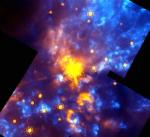 The Heart Of Orion
6.05.2000
Newborn stars lie at at the heart of the the Orion Nebula, hidden from view by the dust and gas of the giant Orion Molecular Cloud number 1 (OMC-1). Sensitive to invisible infrared...
 The Milky Way in Infrared
30.01.2000
At night, from a dark location, part of the clear sky looks milky. This unusual swath of dim light is generally visible during any month and from any location. Until the invention of the telescope, nobody really knew what the "Milky Way" was.
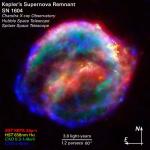 Kepler s SNR from Chandra, Hubble, Spitzer
8.10.2004
Light from the stellar explosion that created this energized cosmic cloud was first seen on planet Earth in October 1604, a mere four hundred years ago. The supernova produced a bright new star in early 17th century skies within the constellation Ophiucus.
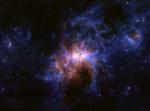 Dusty Environs of Eta Carinae
10.10.2002
Eta Car is a massive star, but it's not as bright as it used to be. Now only easily visible in binoculars or a small telescope, Eta Carinae has a history of spectacular flaring and fading behavior.
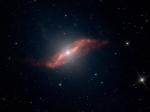 The Galaxy Within Centaurus A
24.06.2004
Peering deep inside Centaurus A, the closest active galaxy to Earth, the Spitzer Space Telescope's penetrating infrared cameras recorded this startling vista. About 1,000 light-years across, the twisted cosmic dust cloud apparently shaped like a parallelogram is likely the result of a smaller spiral galaxy falling into the giant Centaurus A.
|
January February March April May June July August September October |
|||||||||||||||||||||||||||||||||||||||||||||||||