
|
Keyword: Ganymede
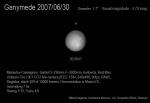 Astronomer s Moon
24.08.2007
Jupiter is an astronomer's planet -- its large size and contrasting global cloud belts and zones allow detailed studies with a range of earthbound telescopes. On the other hand, most telescopic views of Jupiter's moons usually show only featureless, tantalizing points of light hovering near the ruling gas giant.
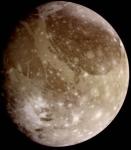 Ganymede: The Largest Moon in the Solar System
20.06.2000
If Ganymede orbited the Sun, it would be considered a planet. The reason is that Jupiter's moon Ganymede is not only the largest moon in the Solar System, it is larger than planets Mercury and Pluto.
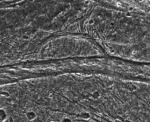 Mysterious Features on Ganymede
9.12.1997
Where is the rest of the circle? Jupiter's largest moon Ganymede has some truly unusual terrain, including the pictured half circle above cut by nearly parallel curves. Full circles can be easily explained by impact craters, but partial circles imply that some resurfacing has occurred since the original impact.
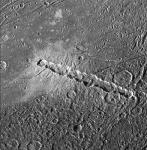 Ganymede: Torn Comet Crater Chain
5.08.1998
This remarkable line of 13 closely spaced craters on Jupiter's moon Ganymede was photographed by the Galileo spacecraft in 1997. The picture covers an area about 120 miles wide and the chain of craters cuts across a sharp boundary between dark and light terrain. What caused this crater chain?
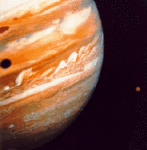 Jupiter, Io, and Ganymede's Shadow
13.10.1995
Jupiter, the solar system's largest planet, is seen here next to Io, its closest Galilean moon. On the cloud tops of Jupiter near the left edge of the picture can be seen a dark circular spot which is caused by the shadow of Jupiter's largest moon Ganymede.
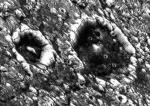 Dark Craters on Ganymede
22.07.1998
Ganymede has craters within craters within craters. The old surface of the largest moon in the Solar System shows its age by the large amount of these impact features. The above picture released last...
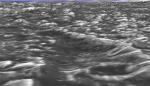 The Hills of Ganymede
23.12.1996
This computer generated 3D close-up view of Jupiter's large moon Ganymede was created using image data from NASA's Galileo spacecraft. Simulating stereo vision by combining two recent images recorded from different angles, 3 dimensional information was reconstructed for a section of Ganymede's surface.
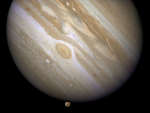 Jupiter Eclipsing Ganymede
6.01.2009
How hazy is Jupiter's upper atmosphere? To help find out, astronomers deployed the Hubble Space Telescope to watch Jupiter eclipse its moon Ganymede. Although Ganymede circles Jupiter once a week, it usually passes above or below the planet, so that a good eclipse occurs more rarely.
|
January February March April May June July August September October |
|||||||||||||||||||||||||||||||||||||||||||||||||