
|
Keyword: equinox
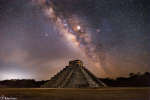 APOD: 2023 March 19 Б Equinox at the Pyramid of the Feathered Serpent
19.03.2023
To see the feathered serpent descend the Mayan pyramid requires exquisite timing. You must visit El Castillo -- in Mexico's Yucatцn Peninsula -- near an equinox. Then, during the late afternoon if the sky is clear, the pyramid's own shadows create triangles that merge into the famous illusion of a slithering viper.
 Sunset at Edmontonhenge
22.09.2016
On September 18, the setting Sun illuminated both sides of the steep brick and steel canyon otherwise known as Jasper Avenue in downtown Edmonton, Alberta, Canada, planet Earth. The Stonehenge-like alignment is captured from the middle of the road in this daring snapshot.
 Sostice to Equinox Cubed
26.03.2016
This 3 month long exposure packed the days from December 22, 2015 through March 20 into a box. Dubbed a solargraph, the unconventional, unfolded picture was recorded with a pinhole camera made from a cube-shaped container, its sides lined with photographic paper.
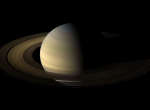 Saturn at Equinox
21.09.2014
How would Saturn look if its ring plane pointed right at the Sun? Before August 2009, nobody knew. Every 15 years, as seen from Earth, Saturn's rings point toward the Earth and appear to disappear.
 Earth at Equinox
22.09.2014
Earth is at equinox. Over the next 24 hours, day and night have nearly equal duration all over planet Earth. Technically, equinox transpires at 2:29 am Universal Time tomorrow, but this occurs today in North and South America.
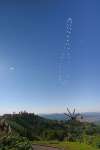 Austrian Analemma
22.09.2012
Today, the Sun crosses the celestial equator heading south at 14:49 Universal Time. An equinox (equal night), this astronomical event marks the first day of autumn in the northern hemisphere and spring in the south.
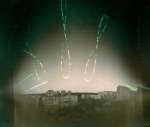 Solargraphy Analemmas
20.03.2014
Today is the equinox. The Sun crosses the celestial equator heading north at 16:57 UT, marking the northern hemisphere's first day of spring. To celebrate, consider this remarkable image following the Sun's yearly trek through planet Earth's sky, the first analemmas exposed every day through the technique of solargraphy.
 Equinox on a Spinning Earth
19.03.2014
When does the line between day and night become vertical? Tomorrow. Tomorrow is an equinox on planet Earth, a time of year when day and night are most nearly equal. At an equinox, the Earth's terminator -- the dividing line between day and night -- becomes vertical and connects the north and south poles.
 Equinox: The Sun from Solstice to Solstice
23.09.2012
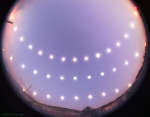
Yesterday was an equinox, a date when day and night are equal. Today, and every day until the next equinox, the night will be longer than the day in Earth's northern hemisphere, and the day will be longer than the night in Earth's southern hemisphere.
 Equinox Earth
28.09.2013
From a geostationary orbit 36,000 kilometers above the equator, Russian meteorological satellite Elektro-L takes high-resolution images our fair planet every 30 minutes. But only twice a year, during an Equinox, can it capture an image like this one, showing an entire hemisphere bathed in sunlight.
|
January February March April May June July August September October |
|||||||||||||||||||||||||||||||||||||||||||||||||