
|
Keyword: planetary nebula
 APOD: 2024 April 30 Б GK Per: Nova and Planetary Nebula
30.04.2024
The star system GK Per is known to be associated with only two of the three nebulas pictured. At 1500 light years distant, Nova Persei 1901 (GK Persei) was the second closest nova yet recorded. At the very center is a white dwarf star, the surviving core of a former Sun-like star.
 NGC 1360: The Robin's Egg Nebula
5.08.2023
This pretty nebula lies some 1,500 light-years away, its shape and color in this telescopic view reminiscent of a robin's egg. The cosmic cloud spans about 3 light-years, nestled securely within the boundaries of the southern constellation Fornax. Recognized as a planetary nebula, egg-shaped NGC 1360 doesn't represent a beginning though.
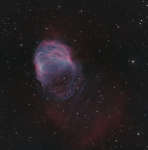 The Medusa Nebula
17.03.2023
Braided and serpentine filaments of glowing gas suggest this nebula's popular name, The Medusa Nebula. Also known as Abell 21, this Medusa is an old planetary nebula some 1,500 light-years away in the constellation Gemini. Like its mythological namesake, the nebula is associated with a dramatic transformation.
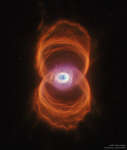 MyCn 18: The Engraved Hourglass Planetary Nebula
29.09.2019
Do you see the hourglass shape -- or does it see you? If you can picture it, the rings of MyCn 18 trace the outline of an hourglass -- although one with an unusual eye in its center. Either way, the sands of time are running out for the central star of this hourglass-shaped planetary nebula.
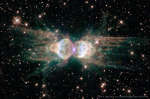 Planetary Nebula Mz3: The Ant Nebula
25.04.2021
Why isn't this ant a big sphere? Planetary nebula Mz3 is being cast off by a star similar to our Sun that is, surely, round. Why then would the gas that is streaming away create an ant-shaped nebula that is distinctly not round?
 APOD: 2023 October 3 Б MyCn 18: The Engraved Hourglass Planetary Nebula
3.10.2023
Do you see the hourglass shape -- or does it see you? If you can picture it, the rings of MyCn 18 trace the outline of an hourglass -- although one with an unusual eye in its center. Either way, the sands of time are running out for the central star of this hourglass-shaped planetary nebula.
 The Medusa Nebula
22.11.2024
Braided and serpentine filaments of glowing gas suggest this nebula's popular name, The Medusa Nebula. Also known as Abell 21, this Medusa is an old planetary nebula some 1,500 light-years away in the constellation Gemini. Like its mythological namesake, the nebula is associated with a dramatic transformation.
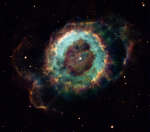 NGC 6369: The Little Ghost Nebula
28.10.2017
Wraithlike NGC 6369 is a faint apparition in night skies popularly known as the Little Ghost Nebula. It was discovered by 18th century astronomer Sir William Herschel as he used a telescope to explore the medicinal constellation Ophiucus. Herschel historically classified the round and planet-shaped nebula as a Planetary Nebula.
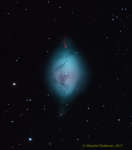 NGC 1360: The Robin s Egg Nebula
11.05.2018
This pretty cosmic cloud lies some 1,500 light-years away, it shape and color reminiscent of a blue robin's egg. It spans about 3 light-years, nested securely within the boundaries of the southern constellation Fornax.
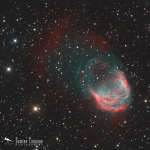 The Medusa Nebula
25.03.2022
Braided and serpentine filaments of glowing gas suggest this nebula's popular name, The Medusa Nebula. Also known as Abell 21, this Medusa is an old planetary nebula some 1,500 light-years away in the constellation Gemini. Like its mythological namesake, the nebula is associated with a dramatic transformation.
|
January February March April May June July August September October |
|||||||||||||||||||||||||||||||||||||||||||||||||