
|
Keyword: planetary nebula
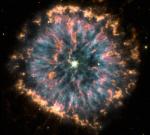 Celebrating Hubble With NGC 6751
7.04.2000
Planetary nebulae do look simple, round, and planet-like in small telescopes. But images from the orbiting Hubble Space Telescope have become well known for showing these fluorescent gas shrouds of dying Sun-like stars to possess a staggering variety of detailed symmetries and shapes.
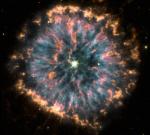 Celebrating Hubble With NGC 6751
16.04.2005
Planetary nebulae can look simple, round, and planet-like in small telescopes. But images from the orbiting Hubble Space Telescope have become well known for showing these fluorescent gas shrouds of dying Sun-like stars to possess a staggering variety of detailed symmetries and shapes.
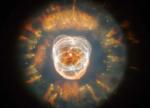 The Eskimo Nebula from Hubble
7.12.2003
In 1787, astronomer William Herschel discovered the Eskimo Nebula. From the ground, NGC 2392 resembles a person's head surrounded by a parka hood. In 2000, the Hubble Space Telescope imaged the Eskimo Nebula. From space, the nebula displays gas clouds so complex they are not fully understood.
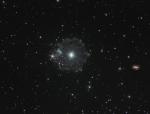 Cat s Eye Wide and Deep
29.06.2007
The Cat's Eye Nebula (NGC 6543) is one of the best known planetary nebulae in the sky. Its more familiar outlines are seen in the the brighter central region of this impressive wide-angle view. But the composite image also combines many short and long exposures to reveal the nebula's extremely faint halo.
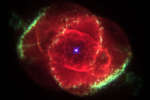 The Cats Eye Nebula
27.12.2009
Three thousand light-years away, a dying star throws off shells of glowing gas. This image from the Hubble Space Telescope reveals the Cat's Eye Nebula to be one of the most complex planetary nebulae known.
 M2 9: Wings of a Butterfly Nebula
27.12.1998
Are stars better appreciated for their art after they die? Actually, stars usually create their most artistic displays as they die. In the case of low-mass stars like our Sun and M2-9 pictured above, the stars transform themselves from normal stars to white dwarfs by casting off their outer gaseous envelopes.
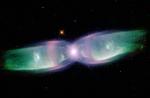 M2 9: Wings of a Butterfly Nebula
12.06.2005
Are stars better appreciated for their art after they die? Actually, stars usually create their most artistic displays as they die. In the case of low-mass stars like our Sun and M2-9 pictured above, the stars transform themselves from normal stars to white dwarfs by casting off their outer gaseous envelopes.
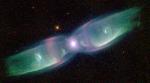 M2 9: Wings of a Butterfly Nebula
21.03.1999
Are stars better appreciated for their art after they die? Actually, stars usually create their most artistic displays as they die. In the case of low-mass stars like our Sun and M2-9 pictured above, the stars transform themselves from normal stars to white dwarfs by casting off their outer gaseous envelopes.
 NGC 3242: The 'Ghost of Jupiter' Planetary Nebula
31.03.1997
It's a weed, it's Jupiter, no it's - actually planetary nebula NGC 3242. After a star like our Sun completes fusion in its core, it throws off its outer layers it a striking display called a planetary nebula.
 NGC 6826: The Blinking Eye
19.12.1997
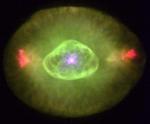
The colorful planetary nebula phase of a sun-like star's life is brief. Almost in the "blink of an eye" - cosmically speaking - the star's outer layers are cast off, forming an expanding emission nebula. This nebula lasts perhaps 10 thousand years compared to a 10 billion year stellar life span.
|
January February March April May June July August September October |
|||||||||||||||||||||||||||||||||||||||||||||||||