
|
Keyword: planetary nebula
 Planetary Nebula Abell 7
7.03.2025
Very faint planetary nebula Abell 7 is about 1,800 light-years distant. It lies just south of Orion in planet Earth's skies toward the constellation Lepus, The Hare. Surrounded by Milky Way stars...
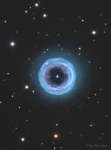 APOD: 2026 March 4 Б Shapley 1: An Annular Planetary Nebula
4.03.2026
WhatБs looking back at you isnБt a cosmic eye, but Shapley 1, a beautifully symmetric planetary nebula. Shapley 1, also known as the Fine Ring Nebula or PLN 329+2.1, bejewels the southern sky constellation of the Carpenter's Square (Norma).
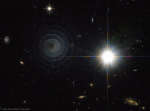 The Extraordinary Spiral in LL Pegasi
11.12.2016
What created the strange spiral structure on the left? No one is sure, although it is likely related to a star in a binary star system entering the planetary nebula phase, when its outer atmosphere is ejected.
 Cat s Eye Wide and Deep
28.05.2016
The Cat's Eye Nebula (NGC 6543) is one of the best known planetary nebulae in the sky. Its more familiar outlines are seen in the brighter central region of the nebula in this impressive wide-angle view. But the composite image combines many short and long exposures to also reveal an extremely faint outer halo.
 The Cats Eye Nebula
3.07.2016
Three thousand light-years away, a dying star throws off shells of glowing gas. This image from the Hubble Space Telescope reveals the Cat's Eye Nebula to be one of the most complex planetary nebulae known.
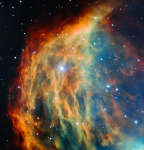 The Medusa Nebula
12.06.2015
Braided, serpentine filaments of glowing gas suggest this nebula's popular name, The Medusa Nebula. Also known as Abell 21, this Medusa is an old planetary nebula some 1,500 light-years away along the southern border of the constellation Gemini. Like its mythological namesake, the nebula is associated with a dramatic transformation.
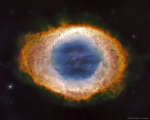 M57: The Ring Nebula
17.04.2018
Except for the rings of Saturn, the Ring Nebula (M57) is probably the most famous celestial band. Its classic appearance is understood to be due to our own perspective, though. The recent mapping...
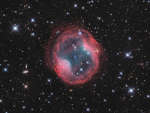 Jones Emberson 1
24.02.2023
Planetary nebula Jones-Emberson 1 is the death shroud of a dying Sun-like star. It lies some 1,600 light-years from Earth toward the sharp-eyed constellation Lynx. About 4 light-years across, the expanding remnant...
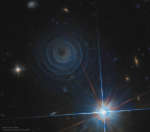 The Extraordinary Spiral in LL Pegasi
8.07.2018
What created the strange spiral structure on the upper left? No one is sure, although it is likely related to a star in a binary star system entering the planetary nebula phase, when its outer atmosphere is ejected.
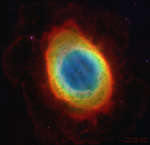 M57: The Ring Nebula from Hubble
17.08.2021
Except for the rings of Saturn, the Ring Nebula (M57) is probably the most famous celestial circle. Its classic appearance is understood to be due to our own perspective, though. The recent mapping...
|
January February March April May June July August September October |
|||||||||||||||||||||||||||||||||||||||||||||||||