
|
Keyword: dark nebula
 Lynds Dark Nebula 43
30.10.2025
Sure, Halloween is an astronomy holiday. But astronomers always enjoy scanning the heavens for spook-tacular galaxies, stars, and nebulae. This favorite is item number 43 from the Beverly Lynds 1962 Catalog of Dark Nebulae, fondly known as the Cosmic Bat nebula.
 APOD: 2026 July 31 Б NGC 4372 and the Dark Doodad
31.07.2026
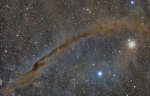
The Dark Doodad Nebula drifts through southern skies, a tantalizing target for binoculars toward the small constellation Musca, The Fly. A dusty interstellar cloud, it's seen against rich starfields just south of the Coalsack Nebula and the Southern Cross.
 The Dark Tower in Scorpius
22.08.2024
In silhouette against a crowded star field along the tail of the arachnological constellation Scorpius, this dusty cosmic cloud evokes for some the image of an ominous dark tower. In fact, monstrous clumps...
 APOD: 2024 July 22 Б Chamaeleon Dark Nebulas
22.07.2024
Sometimes the dark dust of interstellar space has an angular elegance. Such is the case toward the far-south constellation of Chamaeleon. Normally too faint to see, dark dust is best known for blocking visible light from stars and galaxies behind it.
 APOD: 2024 October 27 Б LDN 43: The Cosmic Bat Nebula
27.10.2024
What is the most spook-tacular nebula in the galaxy? One contender is LDN 43, which bears an astonishing resemblance to a vast cosmic bat flying amongst the stars on a dark Halloween night. Located...
 APOD: 2024 June 25 Б The Dark Doodad Nebula
25.06.2024
What is that strange brown ribbon on the sky? When observing the star cluster NGC 4372, observers frequently take note of an unusual dark streak nearby running about three degrees in length. The streak, actually a long molecular cloud, has become known as the Dark Doodad Nebula.
 The Magnificent Horsehead Nebula
13.05.2015
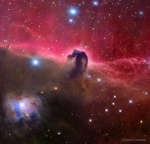
Sculpted by stellar winds and radiation, a magnificent interstellar dust cloud by chance has assumed this recognizable shape. Fittingly named the Horsehead Nebula, it is some 1,500 light-years distant, embedded in the vast Orion cloud complex.
 APOD: 2023 November 20 Б The Horsehead Nebula
20.11.2023
Sculpted by stellar winds and radiation, a magnificent interstellar dust cloud by chance has assumed this recognizable shape. Fittingly named the Horsehead Nebula, it is some 1,500 light-years distant, embedded in the vast Orion cloud complex.
 Lynds Dark Nebula 183
21.10.2017
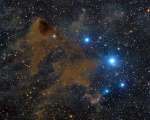
Beverly Lynds Dark Nebula 183 lies a mere 325 light-years away, drifting high above the plane of our Milky Way Galaxy. Obscuring the starlight behind it when viewed at optical wavelengths, the dark, dusty molecular cloud itself seems starless.
 Horsehead: A Wider View
9.03.2018
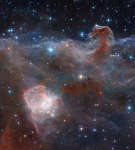
Combined image data from the massive, ground-based VISTA telescope and the Hubble Space Telescope was used to create this wide perspective of the interstellar landscape surrounding the famous Horsehead Nebula. Captured at near-infrared wavelengths...
|
January February March April May June July August September October |
|||||||||||||||||||||||||||||||||||||||||||||||||