
|
Keyword: interacting galaxies
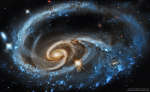 UGC 1810: Wildly Interacting Galaxy from Hubble
17.10.2020
What's happening to this spiral galaxy? Although details remain uncertain, it surely has to do with an ongoing battle with its smaller galactic neighbor. The featured galaxy is labelled UGC 1810 by itself, but together with its collisional partner is known as Arp 273.
 APOD: 2025 August 19 Б Giant Galaxies in Pavo
18.08.2025
Over 500,000 light years across, NGC 6872 (bottom left) is a truly enormous barred spiral galaxy. At least 5 times the size of our own large Milky Way, NGC 6872 is the largest known spiral galaxy.
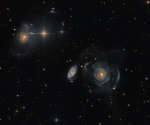 Shell Galaxies in Pisces
26.08.2020
This intergalactic skyscape features a peculiar system of galaxies cataloged as Arp 227 some 100 million light-years distant. Swimming within the boundaries of the constellation Pisces, Arp 227 consists of the two galaxies prominent right of center, the curious shell galaxy NGC 474 and its blue, spiral-armed neighbor NGC 470.
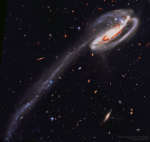 The Tadpole Galaxy from Hubble
20.06.2021
Why does this galaxy have such a long tail? In this stunning vista, based on image data from the Hubble Legacy Archive, distant galaxies form a dramatic backdrop for disrupted spiral galaxy Arp 188, the Tadpole Galaxy. The cosmic tadpole is a mere 420 million light-years distant toward the northern constellation of the Dragon (Draco).
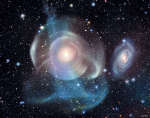 APOD: 2026 July 12 Б Galaxy NGC 474: Shells and Star Streams
11.07.2026
What's happening to galaxy NGC 474? The multiple layers of emission appear strangely complex given the relatively featureless appearance of the elliptical galaxy in less deep images. The cause of the shells...
 Galaxies in the River
10.12.2025
Large galaxies grow by eating small ones. Even our own galaxy engages in a sort of galactic cannibalism, absorbing small galaxies that are too close and are captured by the Milky Way's gravity.
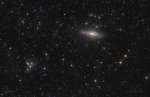 Galaxies in Pegasus
14.10.2020
This sharp telescopic view reveals galaxies scattered beyond the stars of the Milky Way, at the northern boundary of the high-flying constellation Pegasus. Prominent at the upper right is NGC 7331. A mere...
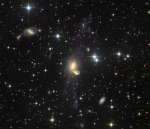 Recycling NGC 5291
20.11.2015
Following an ancient galaxy-galaxy collision 200 million light-years from Earth, debris from a gas-rich galaxy, NGC 5291, was flung far into intergalactic space. NGC 5291 and the likely interloper, also known as the "Seashell" galaxy, are captured near the center of this spectacular scene.
 Arp 87: Merging Galaxies from Hubble
8.12.2015
This dance is to the death. Along the way, as these two large galaxies duel, a cosmic bridge of stars, gas, and dust currently stretches over 75,000 light-years and joins them. The bridge...
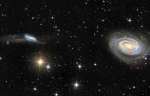 Arp 159 and NGC 4725
2.09.2015
Pointy stars and peculiar galaxies span this cosmic snapshot, a telescopic view toward the well-groomed constellation Coma Berenices. Bright enough to show off diffraction spikes, the stars are in the foreground of the scene, well within our own Milky Way. But the two prominent galaxies lie far beyond our own, some 41 million light-years distant.
|
January February March April May June July August September October |
|||||||||||||||||||||||||||||||||||||||||||||||||