
|
Keyword: supernova remnant
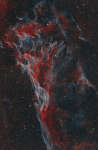 Williamina Fleming s Triangular Wisp
9.11.2017
Chaotic in appearance, these tangled filaments of shocked, glowing gas are spread across planet Earth's sky toward the constellation of Cygnus as part of the Veil Nebula. The Veil Nebula itself is a large supernova remnant, an expanding cloud born of the death explosion of a massive star.
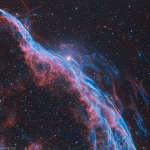 NGC 6960: The Witchs Broom Nebula
7.04.2018
Ten thousand years ago, before the dawn of recorded human history, a new light would have suddenly have appeared in the night sky and faded after a few weeks. Today we know this light was from a supernova, or exploding star, and record the expanding debris cloud as the Veil Nebula, a supernova remnant.
 Pickering s Triangle in the Veil
16.09.2015
Chaotic in appearance, these filaments of shocked, glowing gas break across planet Earth's sky toward the constellation of Cygnus, as part of the Veil Nebula. The Veil Nebula itself is a large supernova remnant, an expanding cloud born of the death explosion of a massive star.
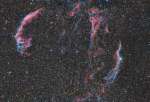 Wisps of the Veil Nebula
26.11.2012
Wisps like this are all that remain visible of a Milky Way star. About 9,000 years ago that star exploded in a supernova leaving the Veil Nebula, also known as the Cygnus Loop.
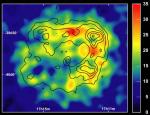 Supernova Remnant Imaged in Gamma Rays
4.11.2004
Gamma rays are the most energetic form of light. With up to a billion times the energy of ordinary "medical" x-rays, they easily penetrate telescope lenses and mirrors, making it very difficult to create gamma-ray images of cosmic sources.
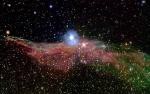 NGC 6960: The Witch's Broom Nebula
23.08.2000
Ten thousand years ago, before the dawn of recorded human history, a new light must suddenly have appeared in the night sky and faded after a few weeks. Today we know this light was an exploding star and record the colorful expanding cloud as the Veil Nebula.
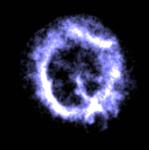 X-ray Hot Supernova Remnant in the SMC
8.12.1999
The Q-shaped cloud seen in this false-color X-ray image from the orbiting Chandra Observatory is big ... about 40 light-years across. It's hot too, as its X-ray glow is produced by multi-million degree gas.
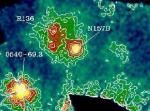 Ultra Fast Pulsar
10.02.1998
Pulsars are rotating neutron stars, born in the violent crucibles of supernova explosions. Like cosmic lighthouses, beams of radiation from surface hotspots sweep past our viewpoint creating pulses which reveal the rotation rates of these incredibly dense stellar corpses. The most famous pulsar of all is found in the nearby supernova remnant, the Crab Nebula.
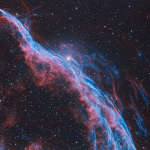 NGC 6960: The Witch s Broom Nebula
29.05.2013
Ten thousand years ago, before the dawn of recorded human history, a new light would have suddenly have appeared in the night sky and faded after a few weeks. Today we know this light was from a supernova, or exploding star, and record the expanding debris cloud as the Veil Nebula, a supernova remnant.
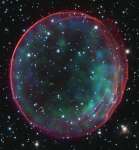 The Case of the Missing Supernova Companion
12.01.2012
Where's the other star? At the center of this supernova remnant should be the companion star to the star that blew up. Identifying this star is important for understanding just how Type...
|
January February March April May June July August September October |
|||||||||||||||||||||||||||||||||||||||||||||||||