
|
Keyword: supernova remnant
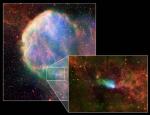 IC 443: Supernova Remnant and Neutron Star
2.06.2006
IC 443 is typical of the aftermath of a stellar explosion, the ultimate fate of massive stars. Seen in this false-color composite image, the supernova remnant is still glowing across the spectrum, from radio...
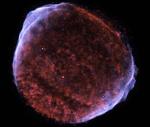 SN 1006: Supernova Remnant in X Rays
26.12.2005
This huge puff ball was once a star. One thousand years ago, in the year 1006, a new star was recorded in the sky that today we know was really an existing star exploding.
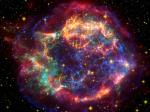 Cassiopeia A Light Echoes in Infrared
15.06.2005
Why is the image of Cassiopeia A changing? Two images of the nearby supernova remnant taken a year apart in infrared light appear to show outward motions at tremendous speeds. This was unexpected since the supernova that created the picturesque nebula was seen 325 years ago. The reason is likely light echoes.
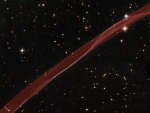 SN 1006: A Supernova Ribbon from Hubble
15.09.2008
What created this unusual space ribbon? Most assuredly, one of the most violent explosions ever witnessed by ancient humans. Back in the year 1006 AD, light reached Earth from a stellar explosion...
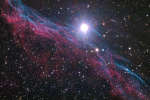 NGC 6960: The Witch s Broom Nebula
19.08.2008
Ten thousand years ago, before the dawn of recorded human history, a new light must suddenly have appeared in the night sky and faded after a few weeks. Today we know this light was an exploding star and record the colorful expanding cloud as the Veil Nebula.
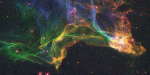 The Cygnus Loop
8.08.1998
15,000 years ago a star in the constellation of Cygnus exploded -- the shockwave from this supernova explosion is still expanding into interstellar space! The collision of this fast moving wall of gas with...
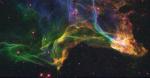 The Cygnus Loop
23.06.2001
The shockwave from a 20,000 year-old supernova in the constellation of Cygnus supernova explosion is still expanding into interstellar space. The collision of this fast moving wall of gas with a stationary cloud...
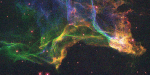 The Cygnus Loop
3.08.1997
15,000 years ago a star in the constellation of Cygnus exploded -- the shockwave from this supernova explosion is still expanding into interstellar space! The collision of this fast moving wall of gas with...
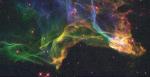 The Cygnus Loop
25.07.1999
The shockwave from a 20,000 year-old supernova in the constellation of Cygnus supernova explosion is still expanding into interstellar space. The collision of this fast moving wall of gas with a stationary cloud...
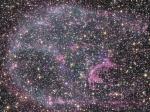 Supernova Remnant N132D in Optical and X Rays
25.10.2005
Thousands of years after a star exploded, its expanding remnant still glows brightly across the spectrum. Such is the case with N132D, a supernova remnant located in the neighboring Large Magellanic Cloud (LMC) galaxy. The expanding shell from this explosion now spans 80 light-years and has swept up about 600 Suns worth of mass.
|
January February March April May June July August September October |
|||||||||||||||||||||||||||||||||||||||||||||||||