
|
Keyword: supernova remnant
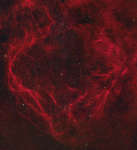 RCW 114: A Dragon s Heart in Ara
11.01.2018
Large and dramatically shaped, this cosmic cloud spans nearly 7 degrees or 14 full moons across planet Earth's sky toward the southern constellation Ara. Difficult to image, the filamentary apparition is cataloged as RCW 114 and traced in this telescopic mosaic by the telltale reddish emission of ionized hydrogen atoms.
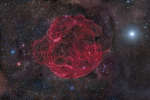 Simeis 147: Supernova Remnant
9.10.2012
It's easy to get lost following the intricate filaments in this detailed mosaic image of faint supernova remnant Simeis 147 (S147). Also cataloged as Sh2-240, it covers nearly 3 degrees or 6 full moons on the sky. That's about 150 light-years at the stellar debris cloud's estimated distance of 3,000 light-years.
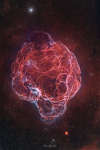 APOD: 2026 January 7 Б Simeis 147: The Spaghetti Nebula Supernova Remnant
7.01.2026
Its popular nickname is the Spaghetti Nebula. Officially cataloged as Simeis 147 and Sharpless 2-240, it is easy to get lost following the looping and twisting filaments of this intricate supernova remnant. Seen toward...
 APOD: 2026 July 24 Б RCW 86: Historical Supernova Remnant
24.07.2026
In 185 AD, Chinese astronomers recorded the appearance of a new star in the Nanmen asterism. That part of the sky is identified with part of the southern constellation Centaurus on modern star charts.
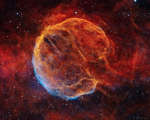 The Medulla Nebula Supernova Remnant
18.01.2021
What powers this unusual nebula? CTB-1 is the expanding gas shell that was left when a massive star toward the constellation of Cassiopeia exploded about 10,000 years ago. The star likely detonated when it ran out of elements, near its core, that could create stabilizing pressure with nuclear fusion.
 APOD: 2025 January 8 Б Supernova Remnants Big and Small
8.01.2025
What happens after a star explodes? A huge fireball of hot gas shoots out in all directions. When this gas slams into the existing interstellar medium, it heats up so much it glows. Two different supernova remnants (SNRs) are visible in the featured image, taken at the Oukaцmeden Observatory in Morocco.
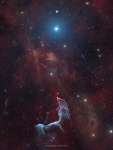 APOD: 2026 June 11 Б The Mermaid Nebula Supernova Remnant
11.06.2026
Could the Little Mermaid turn into stardust instead of seafoam? It would seem so in this beautiful nebula. The featured image shows the Mermaid Nebula, also known as the Betta Fish Nebula, which is part of the G296.5+10.0 Supernova Remnant.
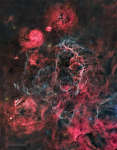 APOD: 2026 June 2 Б The Vela Supernova Remnant
2.06.2026
The explosion is over, but the consequences continue. About twelve thousand years ago, a relatively normal star in the constellation Vela suddenly exploded, creating a strange point of light briefly visible to humans living near the beginning of recorded history.
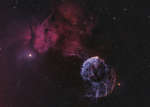 Sharpless 249 and the Jellyfish Nebula
27.02.2026
Normally faint and elusive, the Jellyfish Nebula is caught in this alluring telescopic field of view. Floating in the interstellar sea, the nebula is anchored right and left by two bright stars, Mu and Eta Geminorum, at the foot of the celestial twins.
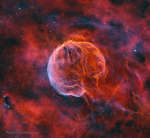 APOD: 2026 January 19 Б CTB 1: The Medulla Nebula
19.01.2026
What powers this unusual nebula? CTB 1 is the expanding gas shell that was left when a massive star toward the constellation of Cassiopeia exploded about 10,000 years ago. The star likely detonated when it ran out of elements, near its core, that could create stabilizing pressure with nuclear fusion.
|
January February March April May June July August September October |
|||||||||||||||||||||||||||||||||||||||||||||||||