
|
Keyword: star
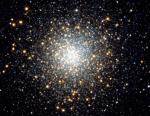 Hydrogen, Helium, and the Stars of M10
12.03.1999
Stars like the Sun use hydrogen for fuel, "burning" hydrogen into helium at their cores through nuclear fusion. But what happens when that hydrogen runs out? For a while, hydrogen burns in a shell surrounding the stellar core and the star expands to become a red giant.
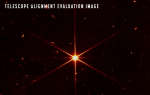 2MASS J17554042 6551277
19.03.2022
2MASS J17554042+6551277 doesn't exactly roll off the tongue but that's the name, a coordinate-based catalog designation, of the star centered in this sharp field of view. Fans of the distant universe should get used to its spiky appearance though.
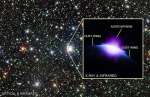 APOD: 2026 March 6 Б The Astrosphere of HD 61005
6.03.2026
Do young stars blow bubbles? The larger view shows a stellar field observed with the Cerro Tololo Inter-American Observatory in Chile, and the inset highlights HD 61005, a star like our Sun, only 120 light-years away.
 APOD: 2025 June 11 Б 25 Brightest Stars in the Night Sky
11.06.2025
Do you know the names of some of the brightest stars? It's likely that you do, even though some bright stars have names so old they date back to near the beginning of written language.
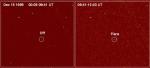 LP 944-20: A Failed Star Flares
13.07.2000
The tiny spot circled on the right actually represents a big astronomical discovery -- the first detected flare from a failed star. Failed stars, termed brown dwarfs in astronomers' parlance, are too low in mass to ignite nuclear hydrogen burning in their cores, yet
 Henrietta Leavitt Calibrates the Stars
3.09.2000
Humanity's understanding of the relative brightness and variability of stars was revolutionized by the work of Henrietta Swan Leavitt (1868-1921). Working at Harvard College Observatory, Leavitt precisely calibrated the photographic magnitudes of 47 stars to which all other stars could be compared.
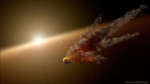 Unexplained Dimmings in KIC 8462852
13.06.2016
Why does star KIC 8462852 keep wavering? Nobody knows. A star somewhat similar to our Sun, KIC 8462852 was one of many distant stars being monitored by NASA's robotic Kepler satellite to see if it had planets.
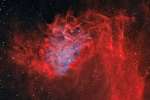 AE Aurigae and the Flaming Star Nebula
11.03.2011
AE Aurigae is the bright star below and left of center in this evocative portrait of IC 405, also known as the Flaming Star Nebula. Embedded in the cosmic cloud, the hot, variable O-type star energizes the glow of hydrogen along convoluted filaments of atomic gas, its blue starlight scattered by interstellar dust.
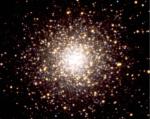 M3: Half A Million Stars
17.09.1999
This immense ball of half a million stars older than the sun lies 30,000 light-years above the plane of our Galaxy. Cataloged as M3 (and NGC 5272), it is one of about 250 globular star clusters which roam our galactic halo.
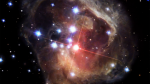 V838 Light Echo: The Movie
17.06.2014
What caused this outburst of V838 Mon? For reasons unknown, star V838 Mon suddenly became one of the brightest stars in the entire Milky Way Galaxy. Then, just a few months later, it faded.
|
January February March April May June July August September October |
|||||||||||||||||||||||||||||||||||||||||||||||||