
|
Keyword: quasar
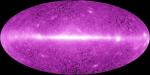 The Gamma Ray Sky
12.01.2002
What if you could see gamma rays? If you could, the sky would seem to be filled with a shimmering high-energy glow from the most exotic and mysterious objects in the Universe.
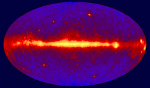 The Gamma Ray Sky
21.03.1998
What if you could "see" gamma rays? If you could, the sky would seem to be filled with a shimmering high-energy glow from the most exotic and mysterious objects in the Universe.
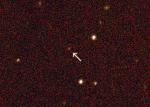 Redshift 5.8: A New Farthest Quasar
19.04.2000
The distance record for a quasar has been broken yet again. At the present time, no other object in the universe has been found to be more distant than the above speck. The recently discovered quasar has been clocked at redshift 5.82.
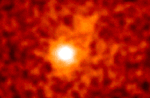 Gamma Ray Quasar
26.12.1998
The bright object in the center of the false color image above is quasar 3C279 viewed in gamma-rays, photons with more than 40 million times the energy of visible light. Like all quasars, 3C279 is a nondescript, faint, star-like object in the visible sky.
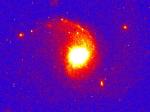 Quasar in an Elliptical Galaxy
9.04.1998
Where do quasars live? Quasars are the brightest objects in the universe, so bright they can be seen from across the universe. Observations continue to show that most quasars are surrounded by a relatively faint nebulous patch. Astronomers are trying to identify the nature of these patches.
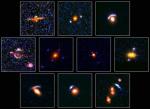 A Gallery of Gravitational Mirages
1.06.1999
The deeper you peer into the universe, the harder it is to see straight. The reason is that distant galaxies act as gravitational lenses, deflecting light that passes nearby. These deflections result in the distortion of background sources, and in some cases the creation of multiple images.
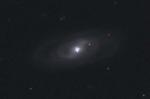 The Einstein Cross Gravitational Lens
10.10.2000
Most galaxies have a single nucleus -- does this galaxy have four? The strange answer leads astronomers to conclude that the nucleus of the surrounding galaxy is not even visible in this image. The central cloverleaf is rather light emitted from a background quasar.
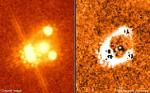 PG 1115: A Ghost of Lensing Past
2.11.1998
In this tangle of quasars and galaxies lies a clue to the expansion rate of the universe. A diffuse glow evident in the picture on the left reveals a normal elliptical galaxy. Directly behind this galaxy lies a normal quasar.
 APM 08279+5255: The Brightest Object Yet Known
18.08.1998
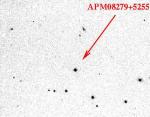
It shines with the brightness of 100 billion Suns. Is it a mirage? The recently discovered quasar labeled APM 08279+5255 has set a new record as being the brightest continuously emitting object yet known.
 A Quasar Portrait Gallery
9.03.2002
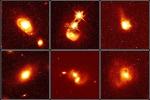
Quasars (QUASi-stellAR objects) lie near the edge of the observable Universe. Discovered in 1963, astronomers were astounded that such objects could be visible across billions of light-years, as this implies they must emit prodigious amounts of energy. Where does the energy come from?
|
January February March April May June July August September October |
|||||||||||||||||||||||||||||||||||||||||||||||||