
|
You entered: Cas A
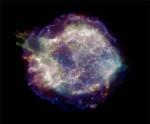 Cas A Supernova Remnant in X Rays
24.08.2002
The complex shell of a star seen to explode 300 years ago is helping astronomers to understand how that star exploded. This Chandra Observatory image of supernova remnant Cassiopeia A (Cas A) shows unprecedented detail in three x-ray colors.
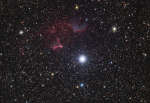 Gamma Cas and Friends
24.12.2009
Gamma Cassiopeiae shines high in northern autumn evening skies. The brightest spiky star in this rich and colorful Milky Way starfield, bluish Gamma Cas marks the central peak in the W-shaped constellation Cassiopeia.
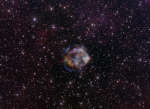 Cas A: Optical and X ray
17.01.2013
The aftermath of a cosmic cataclysm, supernova remnant Cassiopeia A (Cas A) is a comfortable 11,000 light-years away. Light from the Cas A supernova, the death explosion of a massive star, first reached Earth just 330 years ago.
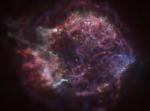 Cas A Supernova Remnant in X Rays
3.01.2000
The complex shell of a star seen to explode 300 years ago is helping astronomers to understand how that star exploded. The above recently released image of supernova remnant Cassiopeia A (Cas A) shows unprecedented detail in three X-ray colors.
 The Ghosts of Gamma Cas
28.10.2023
Gamma Cassiopeiae shines high in northern autumn evening skies. It's the brightest spiky star in this telescopic field of view toward the constellation Cassiopeia. Gamma Cas shares the ethereal-looking scene with ghostly interstellar clouds of gas and dust, IC 59 (top left) and IC 63.
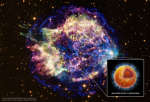 Cooling Neutron Star
1.05.2017
The bright source near the center is a neutron star, the incredibly dense, collapsed remains of a massive stellar core. Surrounding it is supernova remnant Cassiopeia A (Cas A), a comfortable 11,000 light-years away. Light from the Cas A supernova, the death explosion of a massive star, first reached Earth about 350 years ago.
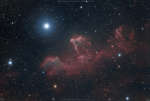 The Ghosts of Cassiopeia
25.10.2019
These bright rims and flowing shapes look ghostly on a cosmic scale. A telescopic view toward the constellation Cassiopeia, the colorful skyscape features swept-back, comet-shaped clouds IC 59 (left) and IC 63. About 600 light-years distant, the clouds aren't actually ghosts.
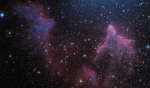 IC 59 and IC 63 in Cassiopeia
26.10.2018
These bright rims and flowing shapes look ghostly on a cosmic scale. A telescopic view toward the constellation Cassiopeia, the colorful (zoomable) skyscape features the swept-back, comet-shaped clouds IC 59 (left) and IC 63.
 Phantoms in Cassiopeia
26.10.2024
These brightly outlined flowing shapes look ghostly on a cosmic scale. A telescopic view toward the constellation Cassiopeia, the colorful skyscape features the swept-back, comet-shaped clouds IC 59 (left) and IC 63. About 600 light-years distant, the clouds aren't actually ghosts.
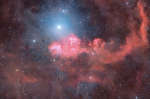 Ghosts in Cassiopeia
31.10.2025
Halloween is an astronomy holiday and spooky shapes always seem to lurk in planet Earth's night skies. In fact, near the center of this telescopic view toward the constellation Cassiopeia these swept-back interstellar clouds IC 59 (left) and IC 63 look ghostly on a cosmic scale.
|
January February March April May June July August September October |
|||||||||||||||||||||||||||||||||||||||||||||||||