
|
You entered: ionization
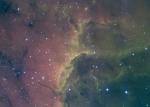 Pelican Nebula Ionization Front
3.07.2000
The Pelican Nebula is slowly being transformed. IC 5070, the official designation, is divided from the larger North America Nebula by a molecular cloud filled with dark dust. The Pelican, however, receives much study because it is a particularly active mix of star formation and evolving gas clouds.
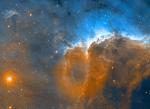 Pelican Nebula Ionization Front
13.10.2003
What's happening to the Pelican Nebula? The light from young energetic stars is slowly transforming the Pelican's cold gas to hot gas, with the advancing boundary between the two known as an ionization front.
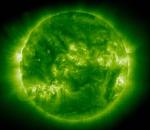 The Iron Sun
29.09.2001
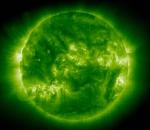
The ultraviolet light emitted by eleven times ionized iron at temperatures over 2 million degrees Farenheit was used to record the above picture of the Sun on September 22, the date of the autumnal equinox.
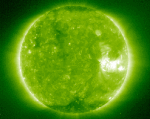 The Iron Sun
21.05.1996
The ultraviolet light emitted by eleven times ionized iron at temperatures over 2 million degrees Farenheit was used to record the above picture of the Sun on May 16. The image was made by the EIT camera onboard the SOHO spacecraft, a space observatory which can continuously observe the Sun.
 The Iron Sun
25.09.2004
The ultraviolet light emitted by eleven times ionized iron at temperatures over 2 million degrees Farenheit was used to record the above picture of the Sun on September 22, 2001, the date of that year's autumnal equinox.
 Shell Game in the LMC
29.12.2016
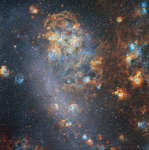
An alluring sight in southern skies, the Large Magellanic Cloud (LMC) is seen here through narrowband filters. The filters are designed to transmit only light emitted by ionized sulfur, hydrogen, and oxygen atoms. Ionized...
 Planetary Nebula Abell 78
16.10.2020
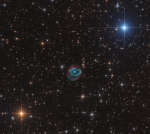
Planetary nebula Abell 78 stands out in this colorful telescopic skyscape. In fact the colors of the spiky Milky Way stars depend on their surface temperatures, both cooler (yellowish) and hotter (bluish) than the Sun.
 NGC 300: A Cosmic Gemstone with Stars and Gas Clouds
16.07.2026
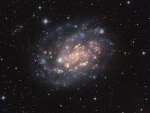
This sparkling, colorful gemstone is a spiral galaxy, NGC 300. It is one of the closest spiral galaxies to Earth, only about 6 million light-years away. But does it really look like this? Here is a more standard portrait of it.
 Flame Nebula Close Up
2.02.2007
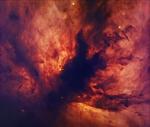
Of course, the Flame Nebula is not on fire. Also known as NGC 2024, the nebula's suggestive reddish color is due to the glow of hydrogen atoms at the edge of the giant Orion molecular cloud complex some 1,500 light-years away.
 Flame Nebula Close Up
26.11.2010
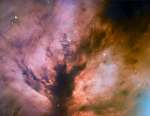
Of course, the Flame Nebula is not on fire. Also known as NGC 2024, the nebula's suggestive reddish color is due to the glow of hydrogen atoms at the edge of the giant Orion molecular cloud complex some 1,500 light-years away.
|
January February March April May June July August |
||||||||||||||||||||||||||||||||||||||||||||||||||||||||