
|
You entered: Earth's atmosphere
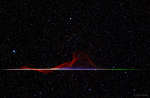 A Colorful Quadrantid Meteor
2.02.2021
Meteors can be colorful. While the human eye usually cannot discern many colors, cameras often can. Pictured is a Quadrantids meteor captured by camera over Missouri, USA, early this month that was not only impressively bright, but colorful. The radiant grit, likely cast off by asteroid 2003 EH1, blazed a path across Earth's atmosphere.
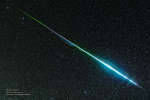 A Rainbow Geminid Meteor
19.12.2018
Meteors can be colorful. While the human eye usually cannot discern many colors, cameras often can. Pictured is a Geminid captured by camera during last week's meteor shower that was not only impressively bright, but colorful.
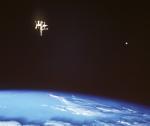 The Moons Of Earth
13.08.1998
While orbiting the planet during their June 1998 mission, the crew of the Space Shuttle Discovery photographed this view of two moons of Earth. Thick storm clouds are visible in the lovely blue planet...
 APOD: 2025 March 4 Б A Quadruple Alignment over Italy
4.03.2025
Why does this Moon look so unusual? A key reason is its vivid red color. The color is caused by the deflection of blue light by Earth's atmosphere -- the same reason that the daytime sky appears blue. The Moon also appears unusually distorted.
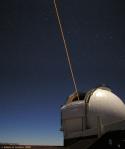 A Telescope Laser Creates an Artificial Star
7.02.2005
What do you get when you combine one of the world's most powerful telescopes with a powerful laser? An artificial star. Monitoring fluctuations in brightness of a genuine bright star can indicate how the Earth's atmosphere is changing, but many times no bright star exists in the direction where atmospheric information is needed.
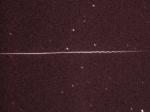 A Twisted Meteor Train
2.02.2005
Did this meteor leave a twisting path? Evidently. Meteor trains that twist noticeably are rare - and even more rarely photographed - but have been noted before. The underlying reason for unusual meteors trains is that many meteors are markedly non-spherical in shape and non-uniform in composition.
 APOD: 2025 April 23 Б An Almost Everything Sky
23.04.2025
This surprising sky has almost everything. First, slanting down from the upper left and far in the distance is the central band of our Milky Way Galaxy. More modestly, slanting down from the upper right and high in Earth's atmosphere is a bright meteor.
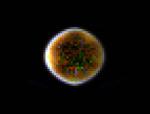 Gamma Ray Earth
3.06.2006
The pixelated planet above is actually our own planet Earth seen in gamma rays - the most energetic form of light. In fact, the gamma rays used to construct this view pack over 35 million electron volts (MeV) compared to a mere two electron volts (eV) for a typical visible light photon.
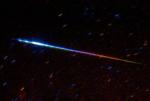 A Perseid Meteor
11.08.2002
The ongoing Perseid Meteor Shower should be at its strongest on August 12 and 13. The best time to watch will be between 2:00 AM and dawn on Monday morning (so plan on setting your alarm tonight!) and then again on Tuesday.
 APOD: 2025 January 7 Б A New Years Aurora and SAR Arc
7.01.2025
It was a new year, and the sky was doubly red. The new year meant that the Earth had returned to its usual place in its orbit on January 1, a place a few days before its closest approach to the Sun.
|
January February March April May June July August September October |
|||||||||||||||||||||||||||||||||||||||||||||||||