
|
You entered: Leonid meteor shower
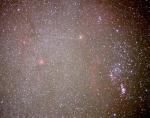 Meteor Milky Way
26.11.1998
The bold, bright star patterns of Orion (right) are a familiar sight to even casual skygazers. But this gorgeous color photo also features a subtler spectacle - the faint stars of the Milky Way.
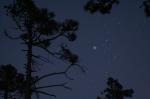 Forest and Sky
17.11.2007
With pine trees in dim silhouette, this skyscape from Breil-sur-Roya in southern France was captured on November 11. In the early evening scene, a satellite seems to streak through the branches, while bright, round, fuzzy Comet Holmes appears to lie just beyond them, near the stars of the constellation Perseus.
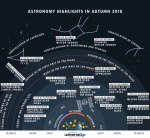 Highlights of the North Autumn Sky
25.09.2018
What can you see in the night sky this season? The featured graphic gives a few highlights for Earth's northern hemisphere. Viewed as a clock face centered at the bottom, early (northern) autumn sky events fan out toward the left, while late autumn events are projected toward the right.
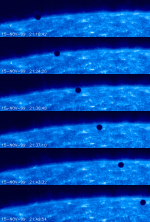 Mercury And The Sun
19.11.1999
Just days before the peak of the Leonid meteor shower, skywatchers were offered another astronomical treat as planet Mercury crossed the face of the Sun on November 15. Viewed from planet Earth, a transit of Mercury is not all that rare. The last occurred in 1993 and the next will happen in 2003.
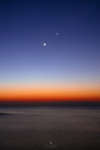 Venus, Mercury, and the Waning Moon
14.11.2020
Yesterday, early morning risers around planet Earth were treated to a waning Moon low in the east as the sky grew bright before dawn. From the Island of Ortigia, Syracuse, Sicily, Italy this simple snapshot found the slender sunlit crescent just before sunrise.
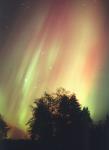 October Skylights
8.11.2000
With brilliant Venus above the western horizon at sunset and Jupiter and Saturn high in the east by early evening, November's night sky is filled with bright planets. October's sky featured bright planets as well and, triggered by the active Sun, some lovely auroral displays.
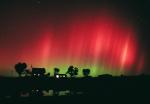 Aurora Oklahoma
13.11.2003
Nestled in the central US, the state of Oklahoma is noted for its gorgeous prairie skies and wide-open spaces, but not for frequent visitations of the northern lights. Still, following the intense solar activity...
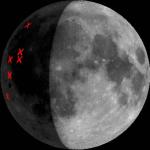 Moon Struck
8.12.2001
Craters produced by ancient impacts on the airless Moon have long been a familiar sight. But only since 1999 have observers seen elusive optical flashes on the lunar surface - likely explosions resulting from impacting meteoroids. These startling observations were made with modest telescopes and video equipment during the 1999 and 2001 Leonid meteor showers.
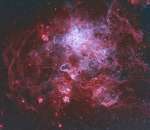 The Tarantula Nebula
16.11.2017
The Tarantula Nebula is more than a thousand light-years in diameter, a giant star forming region within nearby satellite galaxy the Large Magellanic Cloud, about 180 thousand light-years away. The largest, most violent star...
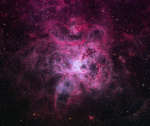 The Tarantula Nebula
17.11.2018
The Tarantula Nebula, also known as 30 Doradus, is more than a thousand light-years in diameter, a giant star forming region within nearby satellite galaxy the Large Magellanic Cloud. About 180 thousand light-years away, it's the largest, most violent star forming region known in the whole Local Group of galaxies.
|
January February March April May June July August September |
|||||||||||||||||||||||||||||||||||||||||||||||||