
|
You entered: Spitzer space telescope
 Massive Star Forming Region DR21 in Infrared
14.04.2004
Deep in the normally hidden recesses of giant molecular cloud DR21, a stellar nursery has been found creating some of the most massive stars yet recorded. The orbiting Spitzer Space Telescope's Infrared Array Camera opened the window into the cloud last year in mid- infrared light.
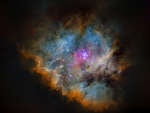 NGC 281: Starless with Stars
19.11.2021
In visible light the stars have been removed from this narrow-band image of NGC 281, a star forming region some 10,000 light-years away toward the constellation Cassiopeia. Stars were digitally added back to the resulting starless image though.
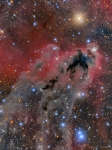 APOD: 2023 January 25 Б LDN 1622: The Boogeyman Nebula
25.01.2023
To some, the dark shape looks like a mythical boogeyman. Scientifically, Lynds' Dark Nebula (LDN) 1622 appears against a faint background of glowing hydrogen gas only visible in long telescopic exposures of the region.
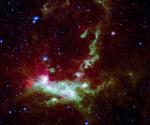 Henize 206: Cosmic Generations
11.03.2004
Peering into a dusty nebula in nearby galaxy the Large Magellanic Cloud, infrared cameras on board the Spitzer Space Telescope recorded this detailed view of stellar nursery Henize 206 filled with newborn stars. The stars appear as white spots within the swirls of dust and gas in the false-color infrared image.
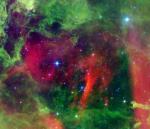 Hot Stars in the Rosette Nebula
26.07.2007
Winds and radiation from massive hot stars in the Rosette Nebula have cleared the natal gas and dust from the center of the nearby star-forming region. They also pose a danger to planet forming disks around young, cooler stars in the neighborhood.
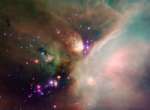 Young Stars in the Rho Ophiuchi Cloud
13.11.2009
Cosmic dust clouds and embedded newborn stars glow at infrared wavelengths in this tantalizing false-color view from the Spitzer Space Telescope. Pictured is of one of the closest star forming regions, part of the Rho Ophiuchi cloud complex some 400 light-years distant near the southern edge of the pronounceable constellation Ophiuchus.
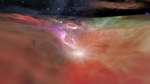 In the Valley of Orion
17.01.2018
This exciting and unfamiliar view of the Orion Nebula is a visualization based on astronomical data and movie rendering techniques. Up close and personal with a famous stellar nursery normally seen from...
 The Valley of Orion
28.08.2020
This exciting and unfamiliar view of the Orion Nebula is a visualization based on astronomical data and movie rendering techniques. Up close and personal with a famous stellar nursery normally seen from...
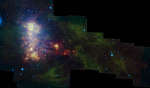 The Tail of the Small Magellanic Cloud
7.01.2010
A satellite galaxy of our Milky Way, the Small Magellanic Cloud is wonder of the southern sky, named for 16th century Portuguese circumnavigator Ferdinand Magellan. Some 200,000 light-years distant in the constellation Tucana...
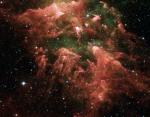 Sculpting the South Pillar
2.06.2005
Eta Carinae, one of the most massive and unstable stars in the Milky Way Galaxy, has a profound affect on its environment. Found in the the South Pillar region of the Carina Nebula, these...
|
January February March April May June July August September October |
|||||||||||||||||||||||||||||||||||||||||||||||||