
|
You entered: comet nucleus
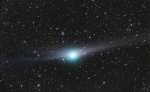 Another Tail for Comet Garradd
3.03.2012
Remarkable comet Garradd (C2009/P1) has come to be known for two distinctive tails. From the perspective of earthbound comet watchers the tails are visible on opposite sides of its greenish coma. Seen here in a telescopic view, the recognizable dust tail fans out to the right, trailing the comet nucleus in its orbit.
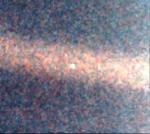 The Largest Rock Known
1.01.1998
There, that faint dot in the center - that's the largest rock known. It is larger than every known asteroid, moon, and comet nucleus. It is larger than any other rocky planet. (Nobody knows...
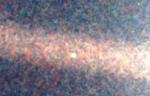 The Largest Rock Known
2.01.2000
There, that faint dot in the center - that's the largest rock known. It is larger than every known asteroid, moon, and comet nucleus. It is larger than any other rocky planet. (Nobody knows...
 A String Of Pearls
24.07.2004
Comet Shoemaker-Levy 9, named after its co-discoverers, was often referred to as the "string of pearls" comet. It is famous for its suggestive appearance as well as its collision with the planet Jupiter!
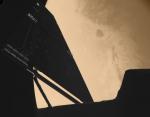 Rosetta Over Mars
1.03.2007
Panels on ESA's Rosetta spacecraft appear in the foreground of this intriguing image of Mars recorded on February 25 at a range of about 1,000 kilometers. Launched in March 2004, Rosetta...
 Comet NEAT (Q4) Over Indian Cove
18.05.2004
Comet NEAT (Q4) was quite photogenic earlier this month. Although the head and part of the tails of Comet C/2001 Q4 (NEAT) were visible to the unaided eye, the best views of the colorful tail were revealed only later by cameras able to expose for long periods.
 The Ion Tail of Comet Hyakutake
19.03.1996
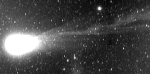
This picture of Comet Hyakutake was taken on March 14, 1996. Structure in the ion tale of Comet Hyakutake is now clearly visible. An ion tale forms as a comet nears the Sun. Sunlight causes gas and dust to boil off the comet's solid nucleus.
 Interstellar Comet 2I Borisov
14.12.2019
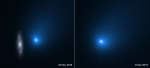
From somewhere else in the Milky Way galaxy, Comet 2I/Borisov is just visiting the Solar System. Discovered by Crimean amateur astronomer Gennady Borisov on August 30, 2019, the first known interstellar comet is captured in these two recent Hubble Space Telescope images.
 A Perseid Meteor and the Milky Way
3.08.2021
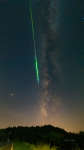
It was bright and green and flashed as it moved quickly along the Milky Way. It left a trail that took 30 minutes to dissipate. Given the day, August 12, and the direction, away...
 The Largest Rock in our Solar System
1.01.2023
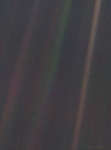
There, that dot on the right, that's the largest rock known in our Solar System. It is larger than every known asteroid, moon, and comet nucleus. It is larger than any other local rocky planet.
|
January February March April |
|||||||||||||||||||||||||||||||||||||||||||||||||