
|
You entered: coronal mass ejection
 APOD: 2024 August 18 Б A Solar Prominence Eruption from SDO
17.08.2024
One of the most spectacular solar sights is an erupting prominence. In 2011, NASA's Sun-orbiting Solar Dynamic Observatory spacecraft imaged an impressively large prominence erupting from the surface. The dramatic explosion was captured in ultraviolet light in the featured time lapse video covering 90 minutes, where a new frame was taken every 24 seconds.
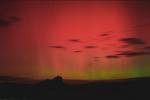 Aurora in Colorado Skies
29.10.2003
Vivid auroral displays were triggered by a cloud of high energy particles from the Sun that collided with planet Earth's magnetosphere yesterday, October 29, at about 06:30 Universal Time. The collision...
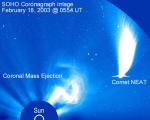 Comet NEAT Passes an Erupting Sun
23.02.2003
As Comet NEAT flared last week, the Sun roared. Just as the comet swooped inside the orbit of Mercury and developed a long and flowing tail of gas and dust, the Sun emitted a huge Coronal Mass Ejection (CME).
 APOD: 2024 October 16 Б Colorful Aurora over New Zealand
15.10.2024
Sometimes the night sky is full of surprises. Take the sky over Lindis Pass, South Island, New Zealand one-night last week. Instead of a typically calm night sky filled with constant stars, a busy and dynamic night sky appeared.
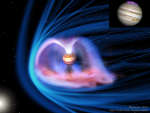 Auroras and the Magnetosphere of Jupiter
5.04.2016
Jupiter has auroras. Like near the Earth, the magnetic field of our Solar System's largest planet compresses when impacted by a gust of charged particles from the Sun. This magnetic compression funnels charged particles towards Jupiter's poles and down into the atmosphere.
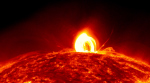 Coronal Rain on the Sun
26.05.2018
Does it rain on the Sun? Yes, although what falls is not water but extremely hot plasma. An example occurred in mid-July 2012 after an eruption on the Sun that produced both a Coronal Mass Ejection and a moderate solar flare. What was more unusual, however, was what happened next.
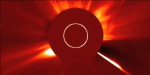 Comet and CME on the Sun
5.10.2011
Did a sun-diving comet just cause a solar explosion? Probably not. This past weekend a comet dove toward the Sun and was followed very quickly by a Coronal Mass Ejection (CMEs) from the other side of the Sun.
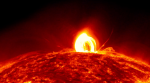 Coronal Rain on the Sun
26.02.2013
Does it rain on the Sun? Yes, although what falls is not water but extremely hot plasma. An example occurred in mid-July 2012 after an eruption on the Sun that produced both a Coronal Mass Ejection and a moderate solar flare. What was more unusual, however, was what happened next.
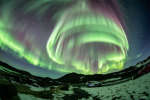 A Vortex Aurora over Iceland
3.04.2022
No, the car was not in danger of being vacuumed into space by the big sky vortex. For one reason, the vortex was really an aurora, and since auroras are created by particles striking the Earth from space, they do not create a vacuum.
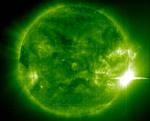 Flare Well AR 10486
5.11.2003
Almost out of view from our fair planet, rotating around the Sun's western edge, giant sunspot region AR 10486 lashed out with another intense solar flare followed by a large coronal mass ejection (CME) on Tuesday, November 4th at about 1950 Universal Time.
|
January February March April May June July August September |
|||||||||||||||||||||||||||||||||||||||||||||||||