
|
You entered: dark nebula
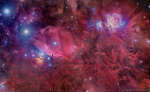 Orion in Gas, Dust, and Stars
10.11.2014
The constellation of Orion holds much more than three stars in a row. A deep exposure shows everything from dark nebula to star clusters, all embedded in an extended patch of gaseous wisps in the greater Orion Molecular Cloud Complex.
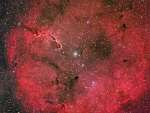 Emission Nebula IC 1396
24.12.2007
Sprawling across hundreds of light-years, emission nebula IC 1396 mixes glowing cosmic gas and dark dust clouds. Stars are forming in this area, only about 3,000 light-years from Earth. This detailed view...
 APOD: 2025 September 2 Б The Horsehead and Flame Nebulas
2.09.2025
The Horsehead Nebula is one of the most famous nebulae on the sky. It is visible as the dark indentation to the orange emission nebula at the far right of the featured picture. The horse-head feature is dark because it is really an opaque dust cloud that lies in front of the bright emission nebula.
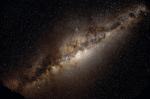 The Milky Way in Stars and Dust
4.10.2005
The disk of our Milky Way Galaxy is home to hot nebulae, cold dust, and billions of stars. This disk can be seen from a dark location on Earth as a band of diffuse light across the sky.
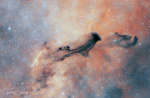 APOD: 2026 February 20 Б B93: A Dark Interstellar Ghost
20.02.2026
"A ghost in the Milky WayББ says Christian Bertincourt, the astrophotographer behind this striking image of Barnard 93 (B93). The 93rd entry in BarnardБs Catalogue of Dark Nebulae, B93 lies within the Small Sagittarius Star Cloud (Messier 24), where its darkness stands in stark contrast to bright stars and gas in the background.
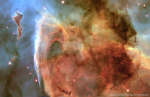 The Keyhole in the Carina Nebula
14.08.2016
The dark dusty Keyhole Nebula gets its name from its unusual shape. The looping Keyhole, in this featured classic image by the Hubble Space Telescope, is a smaller region inside the larger Carina Nebula.
 Alnitak, Alnilam, Mintaka
20.11.2025
Alnitak, Alnilam, and Mintaka are the bright bluish stars from east to west (upper right to lower left) along the diagonal in this cosmic vista. Otherwise known as the Belt of Orion, these three blue supergiant stars are hotter and much more massive than the Sun.
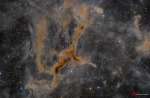 LDN 1295: The Giraffe Nebula
10.09.2026
What does this image look like to you? Many see a giraffe facing right, with neck stretched high and long legs mid-stride (but some may see a squirrel instead). The featured image shows LDN 1295, also called the Giraffe Nebula, in the constellation of the mythical queen of Aethiopia (Cassiopeia).
 The Dark River to Antares
16.05.2020
A dark river seems to flow through this sky from the horizon toward colorful clouds near red giant star Antares. Murky looking, the dark river is a dusty nebula obscuring background starlight near the central Milky Way, although the dark dust nebula contains mostly hydrogen molecular gas.
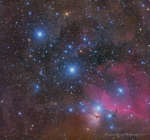 Alnitak, Alnilam, Mintaka
23.11.2017
Alnitak, Alnilam, and Mintaka, are the bright bluish stars from east to west (lower right to upper left) along the diagonal in this cosmic vista. Otherwise known as the Belt of Orion, these three blue supergiant stars are hotter and much more massive than the Sun.
|
January February March April May June July August September October |
|||||||||||||||||||||||||||||||||||||||||||||||||