
|
You entered: origin
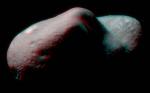 Stereo Eros
24.02.2000
Get out your red/blue glasses and float next to asteroid 433 Eros, 260 million kilometers away! Orbiting the Sun once every 1.8 earth-years, asteroid Eros is a diminutive 40 x 14 x 14 kilometer world of undulating horizons, craters, boulders and valleys.
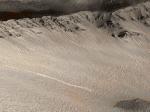 A Year of Extraterrestrial Fountains and Flows
31.12.2006
The past year was extraordinary for the discovery of extraterrestrial fountains and flows -- some offering new potential in the search for liquid water and the origin of life beyond planet Earth.. Increased evidence was uncovered that fountains spurt not only from Saturn's moon Enceladus, but from the dunes of Mars as well.
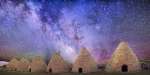 Milky Way Over Abandoned Kilns
25.07.2011
What's that below the Milky Way? Historic kilns. Built in the 1870s in rural Nevada, USA to process local wood into charcoal, the kilns were soon abandon due to a town fire and flooding, but remain in good condition even today.
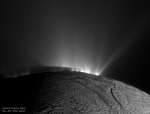 Life Enabling Plumes above Enceladus
16.04.2017
Does Enceladus have underground oceans that could support life? The discovery of jets spewing water vapor and ice was detected by the Saturn-orbiting Cassini spacecraft in 2005. The origin of the water feeding the jets, however, was originally unknown.
 Vega
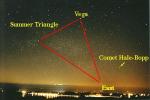
Vega
23.08.1998
Vega is a bright blue star 25 light years away. Vega is the brightest star in the Summer Triangle, a group of stars easily visible summer evenings in the northern hemisphere. The name Vega...
 Europa: Ice Line
18.04.2000
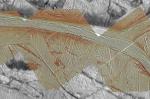
This bright white swath cutting across the surface of icy Jovian moon Europa is known as Agenor Linea. In all about 1000 kilometers long and 5 kilometers wide, only a section is pictured here as part of a combined color and black and white image based on data from the Galileo spacecraft.
 Iapetus: 3D Equatorial Ridge
15.09.2007
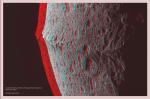
This bizarre, equatorial ridge extending across and beyond the dark, leading hemisphere of Iapetus gives the two-toned Saturnian moon a distinct walnut shape. With red/blue glasses you can check out a remarkable stereo composition of this extraordinary feature -- based on close-up images from this week's Cassini spacecraft flyby.
 620 Kilometers Above Rhea
13.12.2005
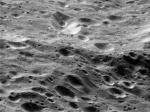
What does the surface of Saturn's moon Rhea look like? To help find out, the robot Cassini spacecraft currently orbiting Saturn was directed to fly right past the second largest moon of the gas giant planet late last month.
 Juno Rockets Toward Jupiter
9.08.2011
Next stop: Jupiter. Last week included one of the few times in history that humanity launched something completely off the Earth, moving away so fast that it will never return. Well, almost -- Juno...
 The Mysterious Rings of Supernova 1987A
26.02.2012
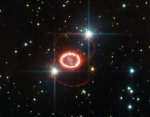
What's causing those odd rings in supernova 1987A? Twenty five years ago, in 1987, the brightest supernova in recent history was seen in the Large Magellanic Clouds. At the center of the above picture is an object central to the remains of the violent stellar explosion.
|
January February March April May June July August September |
|||||||||||||||||||||||||||||||||||||||||||||||||