
|
You entered: phases
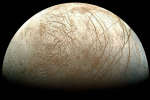 Gibbous Europa
2.12.2007
Although the phase of this moon might appear familiar, the moon itself might not. In fact, this gibbous phase shows part of Jupiter's moon Europa. The robot spacecraft Galileo captured this image mosaic during its mission orbiting Jupiter from 1995 - 2003.
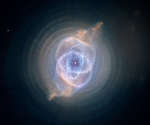 The Cat s Eye Nebula from Hubble
24.04.2011
Staring across interstellar space, the alluring Cat's Eye nebula lies three thousand light-years from Earth. A classic planetary nebula, the Cat's Eye (NGC 6543) represents a final, brief yet glorious phase in the life of a sun-like star.
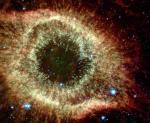 Infrared Helix
12.01.2006
Over six hundred light years from Earth, in the constellation Aquarius, a sun-like star is dying. Its last few thousand years have produced the Helix Nebula (NGC 7293), a well studied and nearby example of a Planetary Nebula, typical of this final phase of stellar evolution.
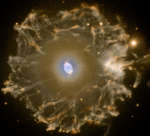 Halo of the Cats Eye
1.06.2014
The Cat's Eye Nebula (NGC 6543) is one of the best known planetary nebulae in the sky. Its haunting symmetries are seen in the very central region of this stunning false-color picture, processed...
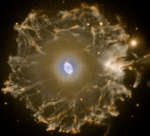 Halo of the Cats Eye
7.06.2020
The Cat's Eye Nebula (NGC 6543) is one of the best known planetary nebulae in the sky. Its haunting symmetries are seen in the very central region of this stunning false-color picture, processed...
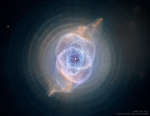 The Cats Eye Nebula from Hubble
10.06.2018
To some, it may look like a cat's eye. The alluring Cat's Eye nebula, however, lies three thousand light-years from Earth across interstellar space. A classic planetary nebula, the Cat's Eye (NGC 6543) represents a final, brief yet glorious phase in the life of a sun-like star.
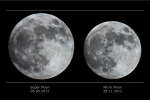 Super Moon vs Micro Moon
29.11.2012
Did you see the big, bright, beautiful Full Moon Wednesday night? That was actually a Micro Moon! On that night, the smallest Full Moon of 2012 reached its full phase only about 4 hours before apogee, the most distant point from Earth in the Moon's elliptical orbit.
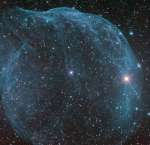 Sharpless 308
23.04.2009
Blown by fast winds from a hot, massive star, this cosmic bubble is huge. Cataloged as Sharpless 308 it lies some 5,200 light-years away in the constellation Canis Major and covers over 2/3 degree on the sky (compared with 1/2 degree for the Full Moon).
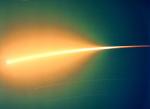 Moon Slide Slim
15.05.2003
No special filters - or even a telescope - are required to enjoy a leisurely lunar eclipse. In fact, watched from all over the night side of planet Earth, these regular celestial performances have entertained many casual skygazers. Still, this eye-catching picture of a lunar eclipse may look unfamiliar.
 Cat s Eye Wide and Deep
28.05.2016
The Cat's Eye Nebula (NGC 6543) is one of the best known planetary nebulae in the sky. Its more familiar outlines are seen in the brighter central region of the nebula in this impressive wide-angle view. But the composite image combines many short and long exposures to also reveal an extremely faint outer halo.
|
January February March April May June July August September |
|||||||||||||||||||||||||||||||||||||||||||||||||