
|
You entered: planetary system
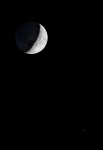 Jupiter and the Moons
5.10.2019
After sunset on October 3, some of the Solar System's largest moons stood low along the western horizon with the largest planet. Just after nightfall, a pairing of the Moon approaching first quarter phase and Jupiter was captured in this telephoto field of view.
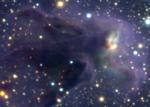 M16: Infrared Star Hunt
4.01.2002
The head of an interstellar gas and dust cloud is shown here in false-color, a near-infrared view recorded by astronomers hunting for stars within M16's Eagle Nebula. Made famous in a 1995 Hubble...
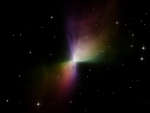 A Beautiful Boomerang Nebula
28.12.2007
This symmetric cloud dubbed the Boomerang Nebula was created by a high-speed wind of gas and dust blowing from an aging central star at speeds of nearly 600,000 kilometers per hour. The rapid...
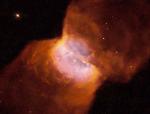 NGC 2346: A Butterfly-Shaped Planetary Nebula
28.10.2001
It may look like a butterfly, but it's bigger than our Solar System. NGC 2346 is a planetary nebula made of gas and dust that has evolved into a familiar shape. At the heart of the bipolar planetary nebula is a pair of close stars orbiting each other once every sixteen days.
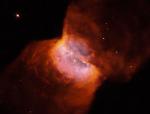 NGC 2346: A Butterfly Shaped Planetary Nebula
12.10.1999
It may look like a butterfly, but it's bigger than our Solar System. NGC 2346 is a planetary nebula made of gas and dust that has evolved into a familiar shape. At the heart of the bipolar planetary nebula is a pair of close stars orbiting each other once every sixteen days.
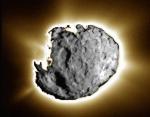 Going Wild
19.03.2004
Dynamic jets of gas and dust surround one of the most active planetary surfaces in the solar system in this wild-looking picture of a comet nucleus. The comet's designation is 81P/Wild...
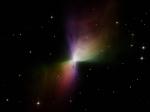 The Boomerang Nebula in Polarized Light
14.09.2005
Why did the Boomerang Nebula form? The symmetric cloud dubbed the Boomerang appears to have been created by a high-speed wind of gas and dust blowing from an aging central star at speeds of nearly 600,000 kilometers per hour.
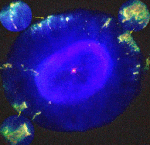 Fliers Around the Blue Snowball Nebula
22.11.1996
Planetary nebulae are strange. First, they are gas clouds and have nothing to do with our Solar System's planets. Next, although hundreds of planetary nebulae have been catalogued and thousands surely exist in our Galaxy, aspects of the formation process are still debated.
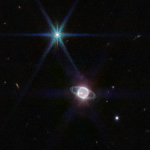 Ringed Ice Giant Neptune
23.09.2022
Ringed, ice giant Neptune lies near the center of this sharp near-infrared image from the James Webb Space Telescope. The dim and distant world is the farthest planet from the Sun, about 30 times farther away than planet Earth.
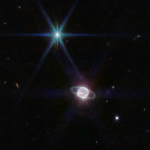 Ringed Ice Giant Neptune
19.08.2023
Ringed ice giant Neptune lies near the center of this sharp near-infrared image from the James Webb Space Telescope. The dim and distant world is the farthest planet from the Sun, about 30 times farther away than planet Earth.
|
January February March April May June July August September |
|||||||||||||||||||||||||||||||||||||||||||||||||