
|
You entered: spectrum
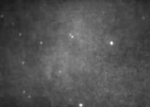 Flashes of the Crab Pulsar
9.02.2021
It somehow survived an explosion that would surely have destroyed our Sun. Now it is spins 30 times a second and is famous for the its rapid flashes. It is the Crab Pulsar, the rotating neutron star remnant of the supernova that created the Crab Nebula.
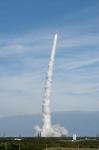 Swift Launches
22.11.2004
Where do gamma ray bursts occur? To help find out, NASA launched the Swift satellite on Saturday, as pictured above. What Swift is designed to do better than any previous satellite is to quickly locate these enigmatic explosions in both sky position and distance.
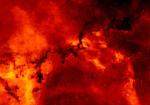 Hydrogen and Dust in the Rosette Nebula
23.12.2005
At the edge of a large molecular cloud in Monoceros, some 3,000 light years away, dark filaments of dust are silhouetted by luminous hydrogen gas. The close up view of the Rosette Nebula...
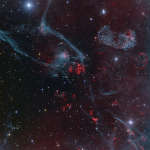 Puppis A Supernova Remnant
29.09.2017
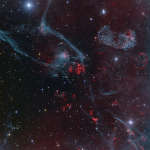
Driven by the explosion of a massive star, supernova remnant Puppis A is blasting into the surrounding interstellar medium about 7,000 light-years away. At that distance, this colorful telescopic field based on broadband and narrowband optical image data is about 60 light-years across.
 Puppis A Supernova Remnant
28.08.2015
Driven by the explosion of a massive star, supernova remnant Puppis A is blasting into the surrounding interstellar medium about 7,000 light-years away. At that distance, this colorful telescopic field based on broadband and narrowband optical image data is about 60 light-years across.
 Iridescent Clouds over Sweden
15.01.2020
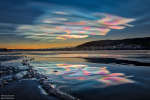
Why would these clouds multi-colored? A relatively rare phenomenon in clouds known as iridescence can bring up unusual colors vividly or even a whole spectrum of colors simultaneously. These polar stratospheric clouds clouds, also known as nacreous and mother-of-pearl clouds, are formed of small water droplets of nearly uniform size.
 High Redshift Quasars
11.12.1998
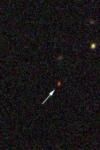
Each red speck indicated above is a powerful quasar estimated to be over 100 times brighter than a galaxy. Yet in these Sloan Digital Sky Survey discovery images the quasars appear faint because they are extremely distant.
 A Powerful Solar Flare
29.10.2003
Yesterday, our Sun produced one of the most powerful solar flares in recorded history. Seen across the electromagnetic spectrum, the Sun briefly became over 100 times brighter in X-rays than normal. Over the next few days, as energetic particles emitted from these regions strike the Earth, satellite communications might be affected and auroras might develop.
 Gemini North Images Bow Shock Near Galactic Center
17.10.2000
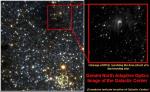
What's going on near the center of our Galaxy? Glowing across the electromagnetic spectrum, the center of our Milky Way Galaxy is thought to be home to massive stars, rotating gas rings, and a massive black hole. Now the central Galactic zoo just got larger.
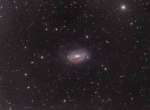 M63: Sunflower Galaxy Wide Field
4.08.2016
The Sunflower Galaxy blooms near the center of this wide field telescopic view. The scene spans about 2 degrees or 4 full moons on the sky toward the loyal constellation Canes Venatici. More formally...
|
January February March April May June July August September October |
|||||||||||||||||||||||||||||||||||||||||||||||||