
|
You entered: star
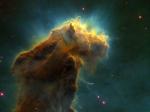 Star EGGs in the Eagle Nebula
22.10.2006
Where do stars form? One place, star forming regions known as "EGGs", are uncovered at the end of this giant pillar of gas and dust in the Eagle Nebula (M16). EGGs, short for evaporating gaseous globules, are dense regions of mostly molecular hydrogen gas that fragment and gravitationally collapse to form stars.
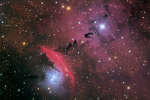 Stars, Dust and Nebula in NGC 6559
2.08.2009
When stars form, pandemonium reigns. A textbook case is the star forming region NGC 6559. Visible above are red glowing emission nebulas of hydrogen, blue reflection nebulas of dust, dark absorption nebulas of dust, and the stars that formed from them.
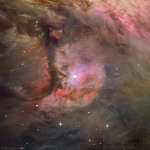 M43: Dust, Gas, and Stars in the Orion Nebula
6.07.2020
Unspeakable beauty and unimaginable bedlam can be found together in the Orion Nebula Arguably the most famous of all astronomy nebulas, the Great Nebula in Orion is an immense interstellar molecular cloud only 1500 light-years away.
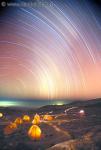 The Star Trails of Kilimanjaro
11.09.2004
The night had no moon, but the stars were out. And camped at 16,000 feet on Mt. Kilimanjaro, photographer Dan Heller recorded this marvelous 3 1/2 hour long exposure. Here the landscape is lit mostly by the stars.
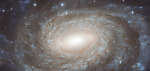 NGC 6384: Spiral Beyond the Stars
22.03.2011
The universe is filled with galaxies. But to see them astronomers must look out beyond the stars of our galaxy, the Milky Way. For example, consider this colorful telescopic view of spiral galaxy NGC 6384, about 80 million light-years away in the direction of the constellation Ophiuchus.
 Savudrija Star Trails
5.06.2025
Savudrija lighthouse shines along the coast near the northern end of the Istrian peninsula in this well-composed night skyscape. A navigational aid for sailors on the Adriatic Sea, the historic lighthouse was constructed in the early 19th century.
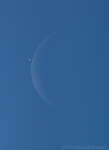 Daytime Moon Meets Morning Star
27.02.2014
Venus now appears as planet Earth's brilliant morning star standing above the eastern horizon before dawn. For most, the silvery celestial beacon rose in a close pairing with an old crescent Moon on February 26.
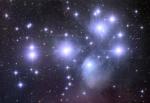 The Pleiades Star Cluster
27.12.2003
Perhaps the most famous star cluster on the sky, the Pleiades can be seen without binoculars from even the depths of a light-polluted city. Also known as the Seven Sisters and M45, the Pleiades is one of the brightest and closest open clusters.
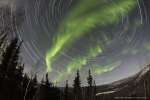 Yukon Aurora with Star Trails
11.03.2010
Fixed to a tripod, a camera can record graceful trails traced by stars as planet Earth rotates on its axis. But at high latitudes during March and April, it can also capture an aurora shimmering in the night.
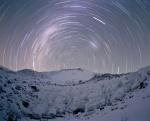 Star Trails at 19 000 Feet
2.12.2006
In myth, Atlas holds up the heavens, but in this stunning view a mountain appears to serve as the southern night sky pivots around a snowy peak. Recorded during a climbing expedition...
|
January February March April May June July August September October |
|||||||||||||||||||||||||||||||||||||||||||||||||