
|
You entered: star formation
 APOD: 2025 December 24 Б Mystery: Little Red Dots in the Early Universe
24.12.2025
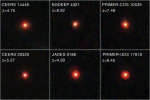
What are these little red dots (LRDs)? Nobody knows. Discovered only last year, hundreds of LRDs have now been found by the James Webb Space Telescope in the early universe. Although extremely faint, LRDs are now frequently identified in deep observations made for other purposes.
 APOD: 2026 August 20 Б The Elephant s Trunk in Cepheus
20.08.2026
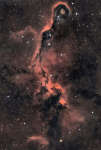
Like an illustration in a galactic Just So Story, the Elephant's Trunk Nebula winds through the emission region and young star cluster complex IC 1396, in the high and far off constellation of Cepheus. Also known as vdB 142, this cosmic elephant's trunk is over 20 light-years long.
 Vista with NGC 2170
15.10.2010
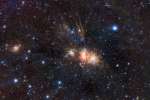
Drifting through the one-horned constellation Monoceros, these dusty streamers and new born stars are part of the active Monoceros R2 star-forming region, embedded in a giant molecular cloud. The cosmic scene was recorded by the VISTA survey telescope in near-infrared light.
 The Tadpole Nebula in Gas and Dust
19.12.2022
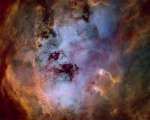
What's causing the commotion in the Tadpole Nebula? Star formation. Dusty emission in the Tadpole Nebula, IC 410, lies about 12,000 light-years away in the northern constellation of the Charioteer (Auriga).
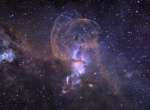 The NGC 3576 Nebula
26.03.2008
An intriguing and beautiful nebula, NGC 3576 drifts through the Sagittarius arm of our spiral Milky Way Galaxy. Within the region, episodes of star formation are thought to contribute to the complex and suggestive shapes. Powerful winds from the nebula's embedded, young, massive stars shape the looping filaments.
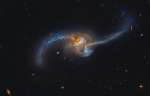 Merging NGC 2623
19.10.2012
NGC 2623 is really two galaxies that are becoming one. Seen to be in the final stages of a titanic galaxy merger, the pair lies some 300 million light-years distant toward the constellation Cancer.
 APOD: 2023 September 19 Б HH 211: Jets from a Forming Star
19.09.2023
Do stars always create jets as they form? No one is sure. As a gas cloud gravitationally contracts, it forms a disk that can spin too fast to continue contracting into a protostar. Theorists hypothesize that this spin can be reduced by expelling jets.
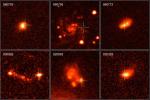 The Host Galaxies of Long Duration GRBs
17.05.2006
What causes the powerful explosions knows as gamma-ray bursts? Astrophysicists still aren't sure, but the longest duration gamma-ray bursts (GRBs) seem to involve very massive stars. A new clue indicating this was uncovered recently by a series of images taken by the orbiting Hubble Space Telescope.
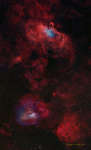 The Eagle and The Swan
24.08.2017
The Eagle Nebula and the Swan Nebula span this broad starscape, a telescopic view toward the Sagittarius spiral arm and the center of our Milky Way galaxy. The Eagle, also known as M16, is at top and M17, the Swan, at bottom of the frame showing the cosmic clouds as brighter regions of active star-formation.
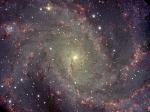 NGC 6946: The Fireworks Galaxy
25.01.2005
Why is this galaxy so active? Nearby spiral galaxy NGC 6946 is undergoing a tremendous burst of star formation with no obvious cause. In many cases spirals light up when interacting with another galaxy, but NGC 6946 appears relatively isolated in space.
|
January February March April May June July August September October |
|||||||||||||||||||||||||||||||||||||||||||||||||