
|
You entered: white dwarf
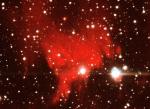 Nebula Nova Cygni Turns On
25.08.2002
Old photographs show no evidence of the above nebula. In 1992, a white dwarf star toward the constellation of Cygnus blew off its outer layers in a classical nova explosion: an event called Nova Cygni 1992.
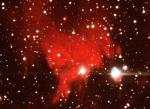 Nebula Nova Cygni Turns On
15.01.2005
Old photographs show no evidence of the above nebula. In 1992, a white dwarf star toward the constellation of Cygnus blew off its outer layers in a classical nova explosion: an event called Nova Cygni 1992.
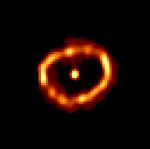 Nova Cygni 1992
26.12.1995
In 1992 a tremendous explosion occurred in the constellation of Cygnus. Dubbed Nova Cygni 1992, this event most probably occurred in an accretion disk binary system. Astronomers hypothesize that this system's white dwarf had so much gas dumped onto it's surface that conditions became ripe for nuclear fusion.
 Nova over Thailand
20.11.2016
A nova in Sagittarius is bright enough to see with binoculars. Detected last month, the stellar explosion even approached the limit of naked-eye visibility last week. A classical nova results from a thermonuclear explosion...
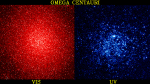 Globular Cluster Omega Centauri
4.10.1996
Does an old, red globular cluster have any hot, blue stars? The rightmost picture, taken by the Ultraviolet Imaging Telescope in ultraviolet light, shows that indeed it does. Pictured, Omega Centauri is the largest known globular cluster in our Galaxy, containing well over a million stars.
 BZ Cam Bow Shock
27.11.2000
BZ Cam is a binary star system that is not well understood. In most cataclysmic variables, matter from a normal star accumulates on the surface of the companion white dwarf star, eventually causing a nova-like flare as the material becomes hot enough to ignite nuclear fusion.
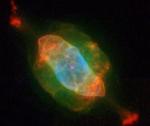 NGC 7009: The Saturn Nebula
29.12.1997
The layers of the Saturn Nebula give a complex picture of how this planetary nebula was created. The above picture, taken in April 1996 and released last week, allows a better understanding of the mysterious process that transformed a low-mass star into a white dwarf star.
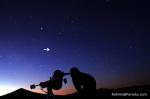 Nova Over Iran
18.02.2007
A bright new nova is being studied by astronomers. The officially dubbed Nova Scorpii 2007 has become so bright in recent days that it is now visible to the unaided eye. Adventurous early morning sky enthusiasts should look in dark skies toward the constellation of the Scorpion, just below Jupiter and Antares.
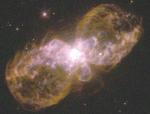 The Hubble 5 Planetary Nebula
18.01.1998
The Hubble Double Bubble Planetary Nebula is bubbling over with excitement. More mundanely known as Hubble 5, this bipolar planetary nebula is being created by a hot wind of particles streaming away from the central star system.
 Messier 4
28.11.2024
Messier 4 can be found west of bright red-giant star Antares, alpha star of the constellation Scorpius. M4 itself is only just visible from dark sky locations, even though the globular cluster of 100,000 stars or so is a mere 5,500 light-years away.
|
January February March April May June July August |
||||||||||||||||||||||||||||||||||||||||||||||||||||||||