
|
You entered: Milky Way
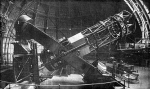 The Hooker Telescope on Mt. Wilson
1.07.1995
In the 1920s, pictures from the Hooker Telescope on Mt. Wilson fundamentally changed our understanding of the cosmos. Astronomer Edwin Hubble, using photographs he took with this telescope, demonstrated that the objects his contemporaries called "spiral nebulae" were actually huge systems of stars - spiral galaxies, similar to our own Milky Way galaxy but incredibly distant.
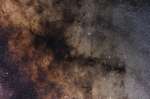 East of Antares
22.05.2009
East of Antares, dark markings sprawl through crowded star fields toward the center of our Milky Way Galaxy. Cataloged in the early 20th century by astronomer E. E. Barnard, the obscuring interstellar dust clouds include B59, B72, B77 and B78, seen in silhouette against the starry background.
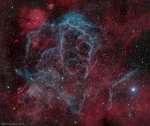 Vela Supernova Remnant
10.09.2010
The plane of our Milky Way Galaxy runs through this complex and beautiful skyscape. At the northwestern edge of the constellation Vela (the Sails) the four frame mosaic is over 10 degrees wide, centered on the glowing filaments of the Vela Supernova Remnant, the expanding debris cloud from the death explosion of a massive star.
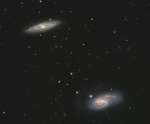 M65 and M66
15.06.2012
Nearby and bright, spiral galaxies M65 (top) and M66 stand out in this engaging cosmic snapshot. The pair are just 35 million light-years distant and around 100,000 light-years across, about the size of our own spiral Milky Way.
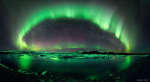 A Starry Night of Iceland
2.01.2016
On some nights, the sky is the best show in town. On this night, the sky was not only the best show in town, but a composite image of the sky won an international competition for landscape astrophotography. The featured winning image was taken in 2011 over JЖkulsАrlСn, the largest glacial lake in Iceland.
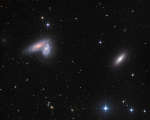 Twin Galaxies in Virgo
31.01.2019
Spiral galaxy pair NGC 4567 and NGC 4568 share this sharp cosmic vista with lonely elliptical galaxy NGC 4564. All are members of the large Virgo Galaxy Cluster. With their classic spiral arms, dust lanes, and star clusters, the eye-catching spiral pair is also known as the Butterfly Galaxies or the Siamese Twins.
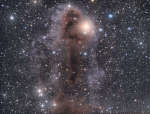 Lynds Dark Nebula 1251
30.05.2019
Stars are forming in Lynds Dark Nebula (LDN) 1251. About 1,000 light-years away and drifting above the plane of our Milky Way galaxy, the dusty molecular cloud is part of a complex of dark nebulae mapped toward the Cepheus flare region.
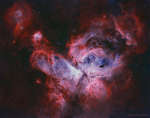 The Great Nebula in Carina
24.04.2022
In one of the brightest parts of Milky Way lies a nebula where some of the oddest things occur. NGC 3372, known as the Great Nebula in Carina, is home to massive stars and changing nebulas. The Keyhole Nebula (NGC 3324), the bright structure just below the image center, houses several of these massive stars.
 APOD: 2025 September 5 Б 47 Tucanae: Globular Star Cluster
4.09.2025
Also known as NGC 104, 47 Tucanae is a jewel of the southern sky. Not a star but a dense cluster of stars, it roams the halo of our Milky Way Galaxy along with some 200 other globular star clusters.
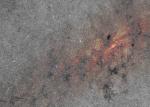 The Galactic Center in Infrared
8.07.2001
The center of our Galaxy is a busy place. In visible light, much of the Galactic Center is obscured by opaque dust. In infrared light, however, dust glows more and obscures less, allowing nearly one million stars to be recorded in the above photograph.
|
January February March April May June July August September October |
|||||||||||||||||||||||||||||||||||||||||||||||||