
|
You entered: galaxies
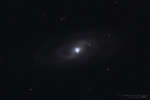 The Einstein Cross Gravitational Lens
17.10.2021
Most galaxies have a single nucleus -- does this galaxy have four? The strange answer leads astronomers to conclude that the nucleus of the surrounding galaxy is not even visible in this image. The central cloverleaf is rather light emitted from a background quasar.
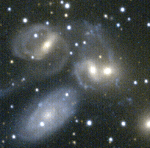 Disorder in Stephan's Quintet
13.12.1996
Five closely grouped galaxies are visible in this image made using the Kitt Peak National Observatory 2.1 meter telescope. The grouping is commonly known as Stephan's Quintet. Four of the galaxies show essentially the same redshift suggesting that they are at the same distance from us.
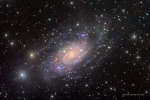 NGC 2403 in Camelopardalis
19.02.2016
Magnificent island universe NGC 2403 stands within the boundaries of the long-necked constellation Camelopardalis. Some 10 million light-years distant and about 50,000 light-years across, the spiral galaxy also seems to have more than its fair share of giant star forming HII regions, marked by the telltale reddish glow of atomic hydrogen gas.
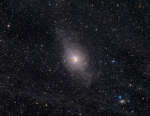 Centaurus A
9.03.2017
Only 11 million light-years away, Centaurus A is the closest active galaxy to planet Earth. Spanning over 60,000 light-years, the peculiar elliptical galaxy also known as NGC 5128, is featured in this sharp telescopic view.
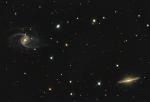 APOD: 2006 September 29- NGC 5905 and 5908
29.09.2006
These two beautiful galaxies, NGC 5905 (left) and NGC 5908 lie about 140 million light-years distant in the northern constellation Draco. Separated by about 500,000 light-years, the pair are actually both spiral galaxies and nicely illustrate the striking contrasts in appearance possible when viewing spirals from different perspectives.
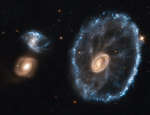 Cartwheel of Fortune
25.01.2018
By chance, a collision of two galaxies has created a surprisingly recognizable shape on a cosmic scale, The Cartwheel Galaxy. The Cartwheel is part of a group of galaxies about 500 million light years away in the constellation Sculptor. Two smaller galaxies in the group are visible on the right.
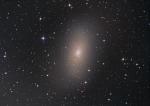 Messier 110
8.09.2006
This very sharp telescopic vista features the last object in the modern version of Charles Messier's catalog of bright clusters and nebulae - Messier 110. A dwarf elliptical galaxy, M110 (aka NGC 205) is actually a bright satellite of the large spiral galaxy Andromeda, making M110 a fellow member of the local group of galaxies.
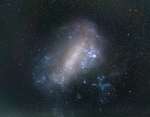 The Large Magellanic Cloud
23.07.2026
Have you ever seen another galaxy with your own eyes? The featured image shows the Large Magellanic Cloud (LMC), one of the closest neighbors of our Milky Way. If you are anywhere south...
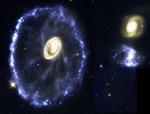 Cartwheel of Fortune
23.02.1997
By chance, a collision of two galaxies has created a surprisingly recognizable shape on a cosmic scale - "The Cartwheel Galaxy". The Cartwheel is part of a group of galaxies about 500 million light years away in the constellation of Sculptor (two smaller galaxies in the group are visible on the right).
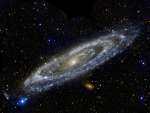 Ultraviolet Rings of M31
24.07.2015
A mere 2.5 million light-years away the Andromeda Galaxy, also known as M31, really is just next door as large galaxies go. So close and spanning some 260,000 light-years, it took 11 different...
|
January February March April May June July August September October |
|||||||||||||||||||||||||||||||||||||||||||||||||