
|
You entered: Milky Way
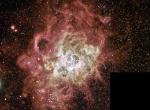 NGC 604: Giant Stellar Nursery
9.12.2003
Stars are sometimes born in the midst of chaos. About 3 million years ago in the nearby galaxy M33, a large cloud of gas spawned dense internal knots which gravitationally collapsed to form stars. NGC 604 was so large, however, it could form enough stars to make a globular cluster.
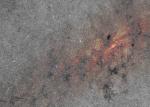 The Galactic Center in Infrared
7.11.2004
The center of our Galaxy is a busy place. In visible light, much of the Galactic Center is obscured by opaque dust. In infrared light, however, dust glows more and obscures less, allowing nearly one million stars to be recorded in the above photograph.
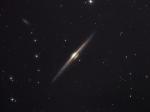 NGC 4565: Galaxy on the Edge
8.07.2005
Magnificent spiral galaxy NGC 4565 is viewed edge-on from planet Earth. Also known as the Needle Galaxy for its narrow profile, bright NGC 4565 is a stop on many telescopic tours of the northern sky as it lies in the faint but well-groomed constellation Coma Berenices.
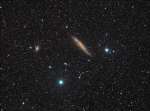 NGC 4945 in Centaurus
9.01.2009
Large, dusty, spiral galaxy NGC 4945 is seen edge-on near the center of this rich telescopic image. The field of view spans nearly 2 degrees, or about 4 times the width of the Full Moon, toward the expansive southern constellation Centaurus.
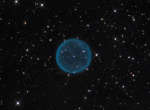 Spherical Planetary Nebula Abell 39
8.10.2012
Ghostly in appearance, Abell 39 is a remarkably simple, spherical nebula about five light-years across. Well within our own Milky Way galaxy, the cosmic sphere is roughly 7,000 light-years distant toward the constellation Hercules.
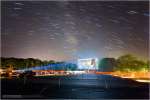 Night at the Drive In
20.09.2013
Colorful stars trail through this late summer, night skyscape from Cape Cod, Massachusetts. The picture was composed by stacking 12 consecutive 1 minute long digital camera exposures to follow the trails, a reflection of our fair planet's daily rotation.
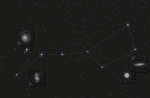 Big Dipper, Deep Sky
23.01.2016
The Big Dipper is an easy to recognize, well-known asterism in northern skies, though many see the Plough or Wagon. Famous bright nebulae of the north can also be found along its familiar lines, highlighted in this carefully composed scene with telescopic insets framed in the wider-field skyview.
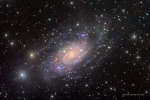 NGC 2403 in Camelopardalis
19.02.2016
Magnificent island universe NGC 2403 stands within the boundaries of the long-necked constellation Camelopardalis. Some 10 million light-years distant and about 50,000 light-years across, the spiral galaxy also seems to have more than its fair share of giant star forming HII regions, marked by the telltale reddish glow of atomic hydrogen gas.
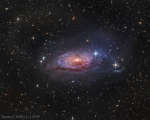 Messier 63: The Sunflower Galaxy
6.06.2019
A bright spiral galaxy of the northern sky, Messier 63 is about 25 million light-years distant in the loyal constellation Canes Venatici. Also cataloged as NGC 5055, the majestic island universe is nearly 100,000 light-years across. That's about the size of our own Milky Way Galaxy.
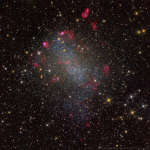 NGC 6822: Barnard s Galaxy
28.11.2020
Grand spiral galaxies often seem to get all the glory, flaunting their young, bright, blue star clusters in beautiful, symmetric spiral arms. But small galaxies form stars too, like nearby NGC 6822, also known as Barnard's Galaxy.
|
January February March April May June July August September October |
|||||||||||||||||||||||||||||||||||||||||||||||||