
|
You entered: outer Galaxy
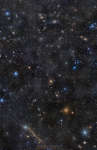 Markarian s Chain to Messier 64
24.06.2017
Top to bottom, this colorful and broad telescopic mosaic links Markarian's Chain of galaxies across the core of the Virgo Cluster to dusty spiral galaxy Messier 64. Galaxies are scattered through the field of view that spans some 20 full moons across a gorgeous night sky.
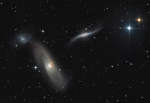 Arp 286: Trio in Virgo
6.07.2016
A remarkable telescopic composition in yellow and blue, this scene features a trio of interacting galaxies almost 90 million light-years away, toward the constellation Virgo. On the right, two, spiky, foreground Milky Way stars echo the trio galaxy hues, a reminder that stars in our own galaxy are like those in the distant island universes.
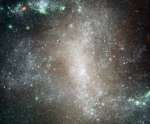 The Star Clusters of NGC 1313
7.08.2009
Like grains of sand on a cosmic beach, individual stars of barred spiral galaxy NGC 1313 are resolved in this sharp composite from the Hubble Space Telescope's Advanced Camera for Surveys (ACS). The inner region of the galaxy is pictured, spanning about 10,000 light-years.
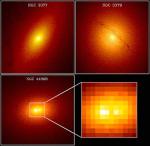 Black Holes and Galactic Centers
14.01.1997
Do all galaxies have black holes at their centers? Although not even a single galaxy has yet been proven to have a central black hole, the list of candidates has increased yet again. Recent...
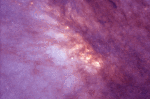 Central Galactic Star Bursts
1.10.1995
The pictured core of the galaxy NGC 253 shows an exceptionally high rate of star formation. In the center are some of the densest knots of stars ever found, surrounded by glowing gas and dust lanes. Galaxies where such high star formation rates are seen are called "starburst" galaxies.
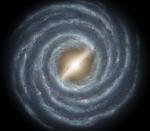 Barred Spiral Milky Way
25.08.2005
A recent survey of stars conducted with the Spitzer Space Telescope is convincing astronomers that our Milky Way Galaxy is not just your ordinary spiral galaxy anymore. Looking out from within the Galaxy's disk, the true structure of the Milky Way is difficult to discern.
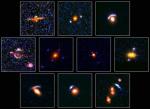 A Gallery of Gravitational Mirages
1.06.1999
The deeper you peer into the universe, the harder it is to see straight. The reason is that distant galaxies act as gravitational lenses, deflecting light that passes nearby. These deflections result in the distortion of background sources, and in some cases the creation of multiple images.
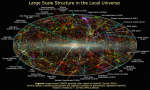 The Universe Nearby
11.12.2007
What does the universe nearby look like? This plot shows over one and a half million of the brightest stars and galaxies in the nearby universe detected by the Two Micron All Sky Survey (2MASS) in infrared light.
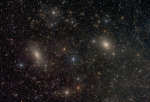 NGC 147 and NGC 185
4.11.2021
Dwarf galaxies NGC 147 (left) and NGC 185 stand side by side in this sharp telescopic portrait. The two are not-often-imaged satellites of M31, the great spiral Andromeda Galaxy, some 2.5 million light-years away.
 APOD: 2026 January 4 Б The Einstein Cross Gravitational Lens
4.01.2026
Most galaxies have a single nucleus -- does this galaxy have four? The strange answer leads astronomers to conclude that the nucleus of the surrounding galaxy is not even visible in this image. The central cloverleaf is rather light emitted from a background quasar.
|
January February March April May June July August September October |
|||||||||||||||||||||||||||||||||||||||||||||||||