
|
You entered: wind
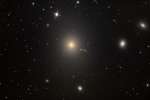 M87: Elliptical Galaxy with Jet
20.05.2010
In spiral galaxies, majestic winding arms of young stars, gas, and dust rotate in a flat disk around a bulging galactic nucleus. But elliptical galaxies seem to be simpler. Lacking gas and dust to form new stars, their randomly swarming older stars, give them an ellipsoidal (egg-like) shape. Still, elliptical galaxies can be very large.
 Comet Olbers over Kunetice Castle
1.08.2024
A visitor to the inner solar system every 70 years or so Comet 13P/Olbers reached its most recent perihelion, or closest approach to the Sun, on June 30 2024. Now on a return voyage...
 APOD: 2025 February 18 Б Thors Helmet versus the Seagull
18.02.2025
Seen as a seagull and a duck, these nebulae are not the only cosmic clouds to evoke images of flight. But both are winging their way across this broad celestial landscape, spanning almost 7 degrees across planet Earth's night sky toward the constellation of the Big Dog (Canis Major).
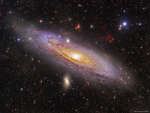 M31: The Andromeda Galaxy
9.09.2019
How far can you see? The most distant object easily visible to the unaided eye is M31, the great Andromeda Galaxy, over two million light-years away. Without a telescope, even this immense spiral galaxy appears as an unremarkable, faint, nebulous cloud in the constellation Andromeda.
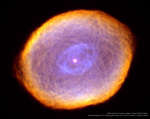 IC 418: The Spirograph Nebula
11.06.2017
What is creating the strange texture of IC 418? Dubbed the Spirograph Nebula for its resemblance to drawings from a cyclical drawing tool, planetary nebula IC 418 shows patterns that are not well understood. Perhaps they are related to chaotic winds from the variable central star, which changes brightness unpredictably in just a few hours.
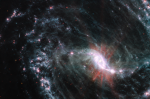 Barred Spiral Galaxy NGC 1365 from Webb
18.02.2023
A mere 56 million light-years distant toward the southern constellation Fornax, NGC 1365 is an enormous barred spiral galaxy about 200,000 light-years in diameter. That's twice the size of our own barred spiral Milky Way.
 Barred Spiral Galaxy NGC 1365 from Webb
13.11.2024
A mere 56 million light-years distant toward the southern constellation Fornax, NGC 1365 is an enormous barred spiral galaxy about 200,000 light-years in diameter. That's twice the size of our own barred spiral Milky Way.
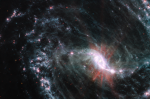 Barred Spiral Galaxy NGC 1365 from Webb
21.01.2026
A mere 56 million light-years distant toward the southern constellation Fornax, NGC 1365 is an enormous barred spiral galaxy about 200,000 light-years in diameter. That's twice the size of our own barred spiral Milky Way.
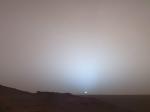 Sunset Over Gusev Crater
20.06.2005
What would it be like to see a sunset on Mars? To help find out, the robotic rover Spirit was deployed last month to park and serenely watch the Sun dip below the distant lip of Gusev crater. It was a tough job, but some robot had to do it.
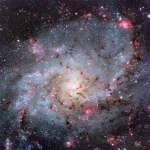 The Hydrogen Clouds of M33
26.12.2013
Gorgeous spiral galaxy M33 seems to have more than its fair share of glowing hydrogen gas. A prominent member of the local group of galaxies, M33 is also known as the Triangulum Galaxy and lies about 3 million light-years distant.
|
January February March April May June July August September October |
|||||||||||||||||||||||||||||||||||||||||||||||||