
|
You entered: dust
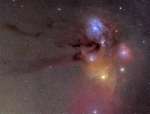 The Dark River to Antares
8.07.2009
Connecting the Pipe Nebula to the colorful regon near bright star Antares is a dark cloud dubbed the Dark River, flowing from the picture's left edge. Murky looking, the Dark River's appearance is caused by dust obscuring background starlight, although the dark nebula contains mostly hydrogen and molecular gas.
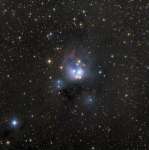 Young Suns of NGC 7129
4.09.2010
Young suns still lie within dusty NGC 7129, some 3,000 light-years away toward the royal constellation Cepheus. While these stars are at a relatively tender age, only a few million years old, it is likely that our own Sun formed in a similar stellar nursery some five billion years ago.
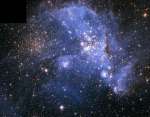 NGC 346 in the Small Magellanic Cloud
17.10.2010
How and why are all these stars forming? Found among the Small Magellanic Cloud's (SMC's) clusters and nebulae NGC 346 is a star forming region about 200 light-years across, pictured above by the Hubble Space Telescope.
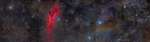 Clouds of Perseus
21.10.2011
Cosmic clouds of gas and dust drift across this magnificent panorama, spanning some 17 degrees near the southern boundary of the heroic constellation Perseus. The collaborative skyscape begins with bluish stars of Perseus at the left, but the eye is drawn to the striking, red NGC 1499.
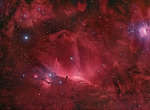 Wisps Surrounding the Horsehead Nebula
9.09.2012
The famous Horsehead Nebula in Orion is not alone. A deep exposure shows that the dark familiar shaped indentation, visible just below center, is part of a vast complex of absorbing dust and glowing gas.
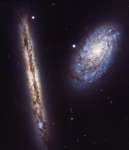 NGC 4302 and NGC 4298
21.04.2017
Seen edge-on, spiral galaxy NGC 4302 (left) lies about 55 million light-years away in the well-groomed constellation Coma Berenices. A member of the large Virgo Galaxy Cluster, it spans some 87,000 light-years, a little smaller than our own Milky Way.
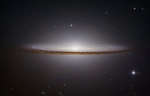 Messier 104
23.04.2022
A gorgeous spiral galaxy, Messier 104 is famous for its nearly edge-on profile featuring a broad ring of obscuring dust lanes. Seen in silhouette against an extensive central bulge of stars, the swath of cosmic dust lends a broad brimmed hat-like appearance to the galaxy suggesting a more popular moniker, the Sombrero Galaxy.
 APOD: 2025 June 26 Б The Seagull Nebula
26.06.2025
An interstellar expanse of glowing gas and obscuring dust presents a bird-like visage to astronomers from planet Earth, suggesting its popular moniker, the Seagull Nebula. This broadband portrait of the cosmic bird covers...
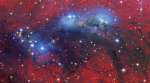 NGC 6914 Nebulae
4.03.2011
A dramatic study in contrasts, this colorful skyscape features stars, dust, and glowing gas in NGC 6914. The complex of nebulae lies some 6,000 light-years away, toward the high-flying northern constellation Cygnus and the plane of our Milky Way Galaxy.
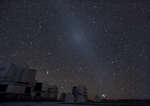 The Gegenschein Over Chile
2.12.2012
Is the night sky darkest in the direction opposite the Sun? No. In fact, a rarely discernable faint glow known as the gegenschein (German for "counter glow") can be seen 180 degrees around from the Sun in an extremely dark sky. The gegenschein is sunlight back-scattered off small interplanetary dust particles.
|
January February March April May June July August September October |
|||||||||||||||||||||||||||||||||||||||||||||||||